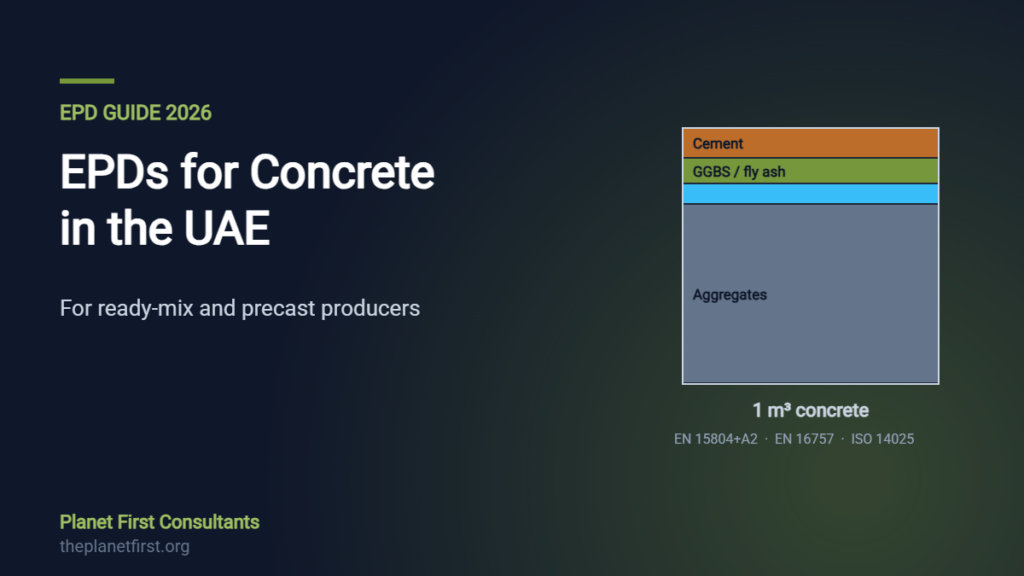
EPDs for Concrete in the UAE: A Guide for Ready-Mix and Precast Producers (2026)
By Danushka Prabhad, Senior Sustainability Consultant, and the Planet First expert team | Published November 2026
Short answer: an Environmental Product Declaration (EPD) for concrete is an independently verified report of the life-cycle environmental impacts of a concrete product, usually one cubic metre of a ready-mix concrete or a defined precast element. It is prepared under ISO 14025, EN 15804+A2 and the concrete-specific rules in EN 16757, and published by a programme operator such as the International EPD System or EPD Hub. For UAE ready-mix and precast producers, an EPD is how contractors, consultants and green-building assessors see the carbon benefit of the GGBS and fly ash already in your mixes.
This guide covers the standards that apply, what drives a concrete EPD’s results, how to handle a large number of mix designs, the data you will need, and the steps from data collection to publication.
Why UAE concrete producers are being asked for EPDs
- Green-building projects. LEED’s Building Product Disclosure and Optimization credit, BREEAM and other rating systems reward the use of products with EPDs, and product-specific, independently verified EPDs are valued more highly than industry averages. See how EPDs and LCA support LEED and BREEAM credits.
- Whole-building life cycle assessments. Design teams increasingly calculate a building’s embodied carbon in LCA software. Without your EPD they use generic data, which rarely reflects UAE mixes with high cement replacement.
- Contractor and developer requests. Developers and contractors with net-zero commitments are starting to ask suppliers for product carbon data, and the reporting requirements of Federal Decree-Law No. 11 of 2024 are increasing the focus on emissions data across UAE supply chains.
- Regional and export tenders. Precast and concrete products supplied to projects in Saudi Arabia and to internationally specified projects are more often required to come with an EPD. Our EPD consultancy in Saudi Arabia covers the KSA side.
Which standards apply to a concrete EPD?
| Standard | Role in a concrete EPD |
|---|
| ISO 14025 | Rules for Type III environmental declarations: programme operation, independent verification and publication. |
| EN 15804:2012+A2:2019 | Core product category rules for all construction products: life-cycle modules, impact indicators and calculation rules. Under A2, modules A1–A3, C1–C4 and D must be declared for most products. |
| EN 16757:2022 | Complementary product category rules for concrete and concrete elements, including declared units and rules for CO₂ uptake through carbonation. |
| Programme PCR | The programme operator’s own rules, for example the International EPD System’s PCR 2019:14 Construction products together with c-PCR-003 Concrete and concrete elements (EN 16757). EPD Hub applies EN 15804+A2 and EN 16757 under its programme rules. |
| ISO 14040 and ISO 14044 | The life cycle assessment method that underlies the EPD. |
For ready-mix concrete, the declared unit is normally 1 m³ of a stated mix and strength class; for precast products it is usually the element or a quantity of it, such as 1 m² of hollow-core slab or 1 tonne of product. Results are reported for each module declared: typically A1–A3 (raw materials, transport to the plant and production), C1–C4 (end of life) and D (benefits and loads beyond the system boundary, such as crushed concrete reused as aggregate). A4 (transport to site) and A5 (installation) are optional but useful in the UAE, where delivery distances vary widely. A published EPD is normally valid for five years. For a general introduction, see everything you need to know about EPDs.
What drives the carbon footprint of a concrete mix
- Cement content and type. Portland cement clinker is the dominant source of global warming potential (GWP) in almost every concrete EPD, so the amount and type of cement per cubic metre largely sets the result.
- Supplementary cementitious materials. Dubai Municipality Circular No. 225 (2018) sets “green cement combinations” for reinforced and prestressed concrete, for example 66–80% GGBS or 36–55% fly ash for certain substructure mixes. Many UAE mixes therefore already have a lower footprint than generic Portland cement data suggests, and an EPD makes that visible. How the upstream impacts of GGBS and fly ash are allocated is set by EN 15804+A2 and the PCR, which is why supplier-specific data for these materials matters.
- Aggregates. Crushed rock and sand contribute through quarrying energy and, often more significantly, transport distance from the quarry to the plant.
- Admixtures. Small by mass and usually small in impact, but they still need to be included.
- Plant energy and hot-weather concreting. Electricity, diesel for loaders and generators, and in the UAE the chilled water and ice used to control the temperature of fresh concrete in summer. These cooling loads belong in module A3 and are often missed.
- Transport. Inbound transport of raw materials (A2) and, if declared, delivery to site (A4).
In practice, two C40/50 mixes from the same plant can differ substantially in GWP depending on the binder. That is why buyers increasingly ask for mix-specific values rather than a single plant average.
One EPD or hundreds of mixes?
A ready-mix plant may run hundreds of mix designs, so the structure of the EPD is a commercial decision as much as a technical one. There are three common approaches:
| Approach | How it works | Best suited to |
|---|
| Product-specific EPD | One verified EPD for one mix or precast product. | A small number of flagship or low-carbon products that you want to promote. |
| Multiple-product EPD | One verified EPD covering a group of similar mixes, using an average or a representative product. Programme operators limit how much results may differ within a group. | Producers that need coverage quickly at lower cost. An average can hide your best mixes. |
| Verified EPD tool | The LCA model is verified once, then the producer generates mix-specific EPDs as needed. Programme operators offer routes for this, such as EPD Hub’s EPD generator and the International EPD System’s process certification. | Producers with many mix designs and frequent tender requests. |
For most UAE ready-mix producers we suggest starting with a small set of product-specific or multiple-product EPDs covering the highest-volume strength classes, then considering a verified tool once tender demand justifies it.
Data you will need
| Area | Data |
|---|
| Mix designs | kg/m³ of each cement, GGBS, fly ash, silica fume, aggregate, water and admixture for every declared mix |
| Production volumes | m³ produced per mix over a representative 12-month period |
| Binder suppliers | The cement, GGBS and fly ash suppliers’ own EPDs or plant-specific data, rather than generic database values |
| Aggregates | Source quarries, aggregate type, transport mode and distance |
| Plant energy | Electricity from DEWA, ADDC, SEWA or Etihad Water and Electricity bills, diesel and other fuels, and energy used for chilled water and ice |
| Water | Potable and recycled water use, including wash-out water |
| Waste and returned concrete | Quantities and how they are handled: recycled, reused or sent to landfill |
| Transport | Mixer truck fuel use and average delivery distance, if A4 is declared |
| End of life | Realistic UAE scenarios for demolition, crushing and reuse of concrete, for modules C1–C4 and D |
From data to a published EPD: the steps
- Scope: agree which plants, mixes and modules the EPD will cover, and choose the programme operator. Our guide to EPD programme operators compares the main options.
- Data collection: gather 12 consecutive months of representative production data using the checklist above.
- LCA modelling: build the life cycle assessment to EN 15804+A2 and EN 16757 using recognised background databases.
- Reporting: prepare the background LCA report and the EPD document in the programme operator’s format.
- Verification: an independent third-party verifier reviews the model, data and documents.
- Registration and publication: the programme operator registers and publishes the EPD, normally valid for five years.
Our step-by-step guide on how to publish an EPD for construction products in the UAE covers each stage in more detail.
Common mistakes in concrete EPDs
- Using generic cement data when the cement supplier has its own EPD.
- Leaving out the energy used to cool concrete in summer.
- Averaging mixes with very different binder contents into one result, which hides low-carbon mixes.
- Ignoring the EN 16757 rules on carbonation, or applying them inconsistently between products.
- Publishing only a PDF. Ask the programme operator for a machine-readable (digital) version so design teams can import your data into their LCA tools.
Once your EPD is published, our guide on how to read an EPD is a useful reference for your sales and technical teams.
Frequently asked questions
Is an EPD the same as a green concrete certificate?
No. An EPD is an independently verified disclosure of environmental impacts. It does not certify that a product is green or meets a threshold; it gives buyers comparable data so they can make that judgement.
How long is a concrete EPD valid?
Normally five years from publication, provided the product, production process and data do not change significantly in the meantime.
Do I need a separate EPD for every concrete mix?
No. You can publish product-specific EPDs for key mixes, a multiple-product EPD for a group of similar mixes, or use a verified EPD tool that generates mix-specific EPDs. The right choice depends on how many mixes you sell and what your customers ask for.
Which programme operator should a UAE concrete producer use?
The International EPD System and EPD Hub are both widely used for construction products in the UAE. Check what your key customers and projects require before choosing.
Does a concrete EPD help with LEED in the UAE?
Yes. Product-specific, independently verified EPDs contribute to LEED’s Building Product Disclosure and Optimization credit. The exact value depends on the LEED version the project is registered under.
Sources
- ISO 14025:2006, Environmental labels and declarations: Type III environmental declarations
- EN 15804:2012+A2:2019, Sustainability of construction works: Environmental product declarations, core rules for the product category of construction products
- EN 16757:2022, Sustainability of construction works: Environmental product declarations, product category rules for concrete and concrete elements
- International EPD System, PCR 2019:14 Construction products and c-PCR-003 Concrete and concrete elements, as applied in this published ready-mix concrete EPD
- Dubai Municipality, Circular No. 225, Attachment 1: Required green cement combinations (2018)