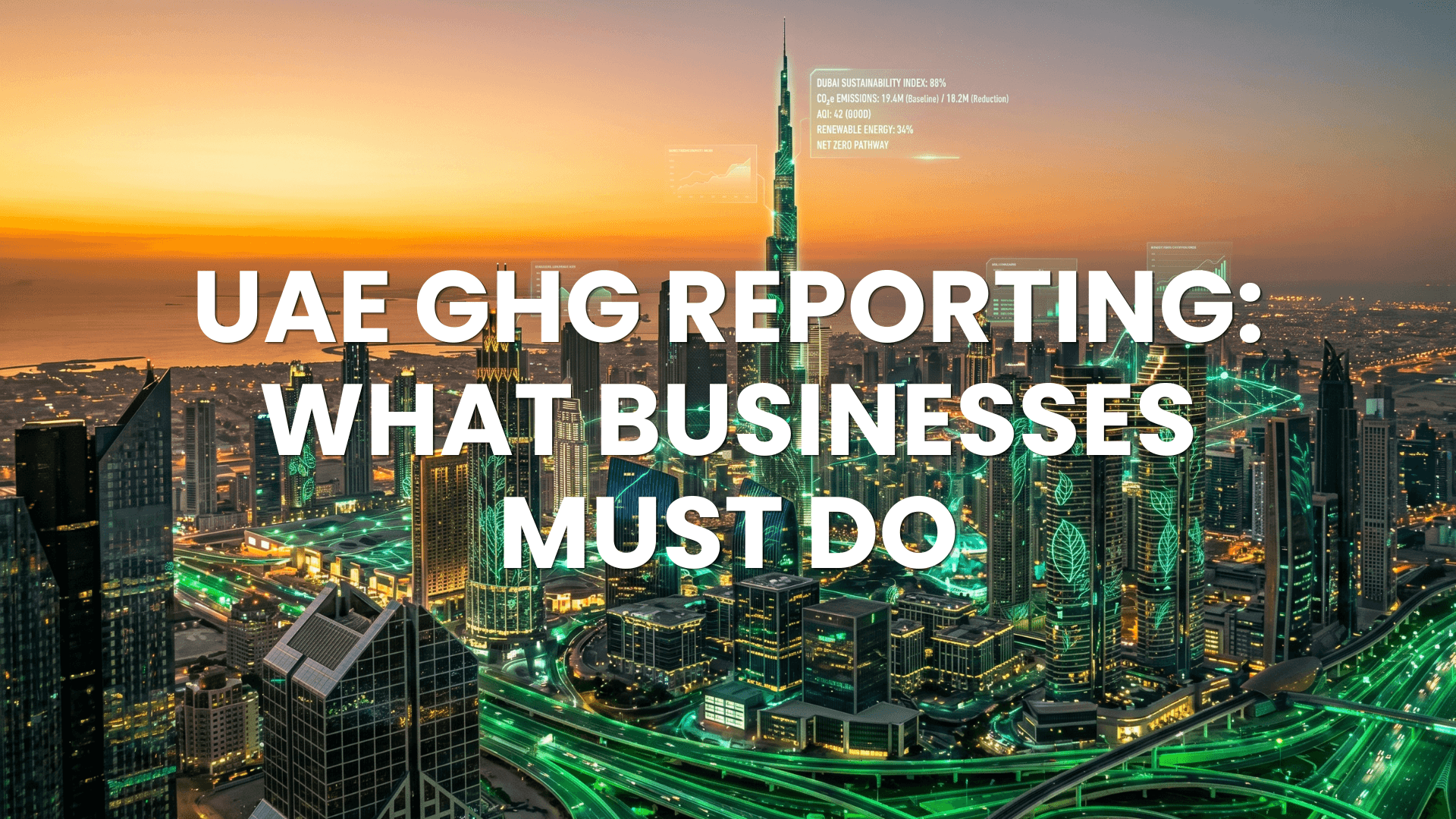

GHG Emissions Calculations & Reporting
Carbon Accounting & GHG Reporting Services for Growing and International Businesses
Carbon Accounting & GHG Reporting Services
Accurate carbon accounting is no longer optional. It is a business requirement.
From supply chain disclosure requests to investor ESG screening and regulatory mandates across the UAE, UK, EU, US, Canada, Australia, and beyond — organizations are expected to measure, manage, and report greenhouse gas (GHG) emissions with clarity and credibility.
Planet First delivers technically rigorous carbon accounting and GHG reporting services aligned with:
GHG Protocol (Corporate & Scope 3 Standards)
ISO 14064
IFRS Sustainability Standards (S2)
TCFD and climate risk frameworks
GRI and investor-focused ESG disclosures
We support growing companies and SMEs that require enterprise-level methodology — without unnecessary complexity.
What Is Carbon Accounting?
Carbon accounting is the structured process of:
Defining organizational and operational boundaries
Identifying Scope 1, Scope 2, and Scope 3 emissions
Collecting activity data across operations and value chains
Applying recognized emission factors
Converting emissions into COâ‚‚e
Preparing structured, decision-useful reports
The outcome is a defensible, audit-ready carbon footprint that supports compliance, procurement, financing, and sustainability strategy.
Scope 1, 2 & 3 Emissions – Full Value Chain Coverage
Understanding emission scopes is fundamental to accurate carbon accounting under the GHG Protocol. Each scope represents a different source of greenhouse gas emissions within an organization’s carbon footprint.
Scope 1 – Direct Emissions
Scope 1 emissions are direct greenhouse gas emissions from sources owned or controlled by the organization.
These typically include:
Fuel combustion in boilers, furnaces, and generators
Company-owned vehicle fleets (diesel, petrol, LPG)
On-site industrial processes
Refrigerant leakage from HVAC or cooling systems
Manufacturing process emissions
Scope 2 – Energy Indirect Emissions
Scope 2 emissions arise from the generation of purchased electricity, steam, heating, or cooling consumed by the organization.
Although these emissions occur at the power plant, they are attributed to the reporting company because the energy is consumed within its operations.
Scope 2 typically includes:
Purchased grid electricity
District cooling (common in UAE and GCC markets)
Purchased steam or heat
Scope 2 emissions are calculated using either:
Location-based emission factors (grid average)
Market-based emission factors (supplier-specific or renewable energy contracts)
For office-based SMEs and service organizations, Scope 2 often represents the largest operational emissions source.
Scope 3 – Value Chain Emissions
Scope 3 emissions are indirect emissions occurring across the organization’s value chain — both upstream and downstream.
These are typically the most complex and often represent the largest share of total emissions.
Scope 3 categories include:
Upstream emissions:
Purchased goods and services
Capital goods
Fuel- and energy-related activities
Upstream transport and distribution
Waste generated in operations
Business travel
Employee commuting
Downstream emissions:
Distribution and logistics
Use of sold products
End-of-life treatment of products
Investments (where applicable)
For companies supplying into international markets, construction, infrastructure, or manufacturing value chains, Scope 3 disclosure is increasingly required by customers and investors.
Because Scope 3 relies on supplier data, industry averages, and estimation methodologies, it requires structured assumptions and transparent documentation to remain credible and audit-ready.
Designed for SMEs – Built with Enterprise-Level Methodology
Many small and mid-sized companies face a critical challenge:
They are required to report emissions by customers, investors, or regulators —
but lack internal sustainability teams or data infrastructure.
We bridge that gap.
Our approach ensures:
Proportional methodology suited to company size
Documentation aligned with verification standards
Clear assumptions and transparent calculations
Scalable systems that grow with the business
You receive reporting that stands up to scrutiny — without enterprise-level bureaucracy.
International Compliance & Multi-Jurisdiction Readiness
Even SMEs increasingly operate across borders.
We support carbon reporting aligned with:
UAE climate disclosure requirements
GCC regulatory developments
UK SECR
EU CSRD-related emissions expectations
US climate disclosure developments
Canadian and Australian sustainability frameworks
IFRS S2 global baseline requirements
This ensures your carbon reporting supports:
Export market access
Supplier qualification
ESG investor screening
EcoVadis and procurement assessments
Common Challenges We Solve
SMEs and growing businesses often struggle with:
Lack of internal sustainability expertise
Fragmented operational data
Unclear emission factor selection
Scope 3 complexity
Regulatory uncertainty
Fear of greenwashing exposure
Our role is to transform carbon reporting from a compliance burden into a structured business tool.
Get Free Consultation With Our Experts
Our Carbon Accounting Process
1. Boundary Definition & Scoping
Establish organizational boundaries and identify relevant emission categories.
2. Data Collection System Design
Create structured templates and data workflows suited to your operations.
3. Emission Calculation
Apply regionally relevant emission factors and convert to COâ‚‚e using recognized methodologies.
4. Carbon Footprint Development
Develop a complete GHG inventory with scope breakdowns and intensity metrics.
5. Reporting & Disclosure Alignment
Prepare structured documentation aligned with GHG Protocol, ISO 14064, and ESG frameworks.
6. Optional Verification Support
Assist with third-party verification preparation where required.
Strategic Report Drafting, Design & Communication
Integration with ESG, EcoVadis & Sustainability Reporting
Carbon data does not stand alone.
We integrate GHG metrics into:
ESG reporting frameworks
EcoVadis submissions
Sustainability reports
Climate risk assessments
Net zero and science-based target preparation
This ensures your emissions data supports broader strategic positioning.
Why Work with Planet First?
Technically grounded in ISO and GHG Protocol standards
Experience supporting both first-time reporters and advanced ESG teams
Structured yet pragmatic methodology
Clear documentation and defensible calculations
Strong understanding of UAE, GCC, UK, EU, North American, and APAC regulatory direction
We operate as a technical partner — not just a reporting vendor.
Frequently Asked Questions About GHG Reporting and Calculations
GHG (Greenhouse Gas) reporting is the structured process of measuring, calculating, and disclosing an organization’s greenhouse gas emissions, expressed in carbon dioxide equivalent (CO₂e).
It measures emissions from:
- Direct fuel use and operations
- Purchased electricity and energy
- Supply chain, transportation, waste, and product use
GHG reporting provides organizations with a quantifiable carbon footprint, which is essential for regulatory compliance, ESG reporting, climate risk management, and setting emissions reduction targets aligned with global climate goals.
GHG reporting includes multiple gases, each converted into COâ‚‚ equivalent (COâ‚‚e) using Global Warming Potential (GWP).
Common gases include:
- Carbon dioxide (COâ‚‚)
- Methane (CHâ‚„)
- Nitrous oxide (Nâ‚‚O)
- Hydrofluorocarbons (HFCs) from refrigerants
Although COâ‚‚ is the most common, gases like methane and refrigerants can have significantly higher climate impact, making accurate conversion critical.
GHG emissions are categorized under the GHG Protocol as follows:
- Scope 1 (Direct emissions): Fuel combustion, company vehicles, generators, process emissions
- Scope 2 (Indirect energy emissions): Purchased electricity, district cooling, steam
- Scope 3 (Value chain emissions): Purchased goods, transportation, waste, business travel, employee commuting, use of sold products
Understanding these scopes allows organizations to identify emission hotspots and target effective reduction actions.
GHG emissions are calculated using a basic formula:
Activity Data Ă— Emission Factor = GHG Emissions
These emissions are then converted into COâ‚‚ equivalent (COâ‚‚e) using GWP values.
Example activities:
- Liters of diesel consumed
- kWh of electricity used
- Kilometers traveled
- Tons of waste generated
This standardized approach ensures consistency and comparability across reporting periods.
Example: Diesel consumption
- Diesel used: 10,000 liters
- Emission factor: 2.68 kg COâ‚‚ per liter
Calculation:
10,000 Ă— 2.68 = 26,800 kg COâ‚‚
Converted to metric tons:
26,800 kg Ă· 1,000 = 26.8 tCOâ‚‚e
This 26.8 tCOâ‚‚e is reported as Scope 1 emissions.
Globally recognized standards include:
- GHG Protocol (most widely used)
- ISO 14064 (GHG quantification and verification)
- TCFD (climate risk disclosure)
- CDP (investor reporting)
- UAE Climate Law and regional guidelines
Using recognized standards ensures credibility, audit readiness, and stakeholder confidence.
Organizations commonly face:
- Incomplete activity data
- Difficulty collecting Scope 3 data
- Incorrect emission factors
- Inconsistent methodologies year-to-year
- Limited internal expertise
Professional support ensures accurate calculations, defensible assumptions, and compliance with international standards.
GHG reporting is the foundation for:
- ESG and sustainability reporting
- EcoVadis climate scoring
- Science-based targets (SBTi)
- Carbon management plans and net-zero roadmaps
Accurate GHG data allows organizations to demonstrate transparency, manage risk, reduce emissions, and improve sustainability performance year after year.
- All Posts
- blog
- Cases
GHG Reporting in Abu Dhabi: The Complete MRV Guide Under UAE Federal Law No. 11...

How EPDs, LCA, and FSC Certified Wood Help Achieve LEED and BREEAM Credits By Danushka...

How to Register Your Company on EcoVadis (Step-by-Step Guide) Learn how to register your company...

ISO 14019: What You Need to Know About the New Sustainability Verification Standard If you’ve...

How to Read an EPD: A Practical Guide for Construction Professionals Why EPDs Are Often...

Everything You Need to Know About EPDs: All Questions Answered Home Everything You Need to...

Case Study 2 Home How Planet First Helped a Market Intelligence Firm Improve Its EcoVadis...

EPD Program Operators: How to Choose, Credibility, and Global Overview If you’re a UAE business...

Why Companies Fail EcoVadis Before Scoring Even Starts: The 55-Document Trap You’ve gathered everything—environmental policies,...

How to Publish EPDs for Construction Products in the UAE: Step-by-Step Guide Publishing an Environmental...

Documents Required for EcoVadis Assessment in the UAE: Essential Checklist for Dubai Companies If your...

How EcoVadis Scoring Works in 2025: Full Framework Explained EcoVadis scoring determines how buyers view...

Case Study: How Q Product Transformed Their EcoVadis Score and Secured Major International Partnerships Client:...

How EPDs Are Revolutionizing Green Construction and Procurement in the UAE As the UAE races...

UAE Federal Decree-Law No. 11 of 2024: Your Complete Business Guide to Climate Compliance As...
Boost Your Sustainability Reporting with Expert Help
Work with Planet First, the certified consultants in the Middle East, and ensure your sustainability performance is fully recognized.
info@theplanetfirst.org
Phone
+971 50 25 35 594
A sustainability consultancy supporting ESG reporting, carbon footprint calculations, and compliance for businesses.
Main Services
GCC/Middle East Specific
Contact
- 112, Normandy 2, Al Nadha 2, Dubai, UAE
- info@theplanetfirst.org
- +971 50 253 5594