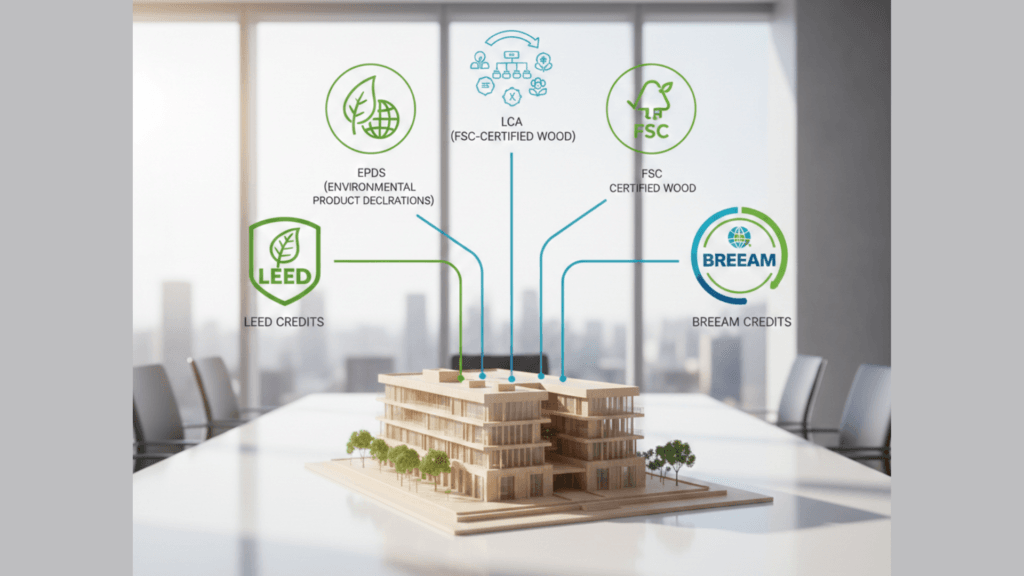
How EPDs Contribute to LEED Credits
Under LEED v4.1 — the current standard applicable to most new projects pursuing certification in 2025 and beyond — EPDs are directly tied to the Materials & Resources (MR) category, specifically through the Building Product Disclosure and Optimization: Environmental Product Declarations credit.
BPDO: EPD Credit Structure
This credit is split into two parts: Disclosure and Optimization.
Disclosure (1 point): Projects must use at least 20 permanently installed building products from at least five different manufacturers that have publicly available EPDs. These can be industry-wide (generic) EPDs or product-specific EPDs.
Optimization (1 point): Products must go further — demonstrating that the materials selected have environmental impacts below the industry average as declared in their EPDs, or that manufacturers have disclosed LCA data and committed to reduction programmes.
In practical terms, this means that for a 10-storey commercial building in Houston or a mixed-use development in Manchester, the project team needs to systematically collect EPDs for structural materials, cladding systems, insulation, finishes, and MEP products. This is not a passive exercise — it requires proactive supply chain engagement.
EPDs and Embodied Carbon Reduction
One increasingly important dimension of LEED v4.1 in 2025 is the focus on whole-life carbon, including embodied carbon — the carbon emissions locked into materials during manufacturing. EPD data feeds directly into whole-building LCA tools such as One Click LCA and Tally, enabling project teams to compare material options and select lower-carbon alternatives.
In the UAE, where rapid construction activity in cities like Riyadh, Abu Dhabi, and Dubai has placed sustainability under the spotlight ahead of national net-zero targets, EPD-driven material selection is becoming a differentiator in developer-led ESG reporting as well as in formal certification.
FSC-Certified Wood and Its Role in LEED and BREEAM Credits
Timber and wood-based products occupy a unique position in sustainable construction. When responsibly sourced, wood is a renewable, low-carbon material with outstanding structural and aesthetic potential. When sourced irresponsibly, it contributes to deforestation, biodiversity loss, and carbon release on a significant scale.
The Forest Stewardship Council (FSC) is the globally recognised body that certifies forests managed according to rigorous environmental, social, and economic standards. FSC-certified wood provides an auditable chain of custody from forest to building site.
FSC Wood and LEED v4.1
Under LEED v4.1, FSC-certified wood contributes primarily to two credit areas:
- Building Product Disclosure and Optimization — Sourcing of Raw Materials (1 point): FSC-certified wood products count toward the 25% by cost threshold for raw materials that are responsibly sourced. Each FSC-certified product counts as contributing 100% of its value to this calculation, compared to other sourcing criteria where only 50% of the value may count.
- Wood and Agrifiber Products pilot credit: For projects in the US that incorporate mass timber — cross-laminated timber (CLT), glulam, or nail-laminated timber — FSC certification is increasingly required by project teams seeking to validate both carbon storage claims and responsible sourcing.
Projects such as the T3 mass timber office buildings in Minneapolis and Atlanta have demonstrated how FSC-certified timber can anchor a LEED Platinum or Gold strategy while also serving as a powerful occupant experience narrative around biophilia and natural materials.
FSC Wood and BREEAM 2018
Under BREEAM 2018, the Mat 06 credit (Material Specification — Responsible Sourcing) is where FSC certification delivers the most direct benefit. The credit awards points based on the proportion of construction elements that can demonstrate responsible sourcing through third-party certification schemes. FSC is one of the highest-rated schemes within the BREEAM framework.
In the UK, where BREEAM is the dominant certification system, specifiers working on schools, healthcare facilities, and offices funded through frameworks such as the UK Government’s Construction Playbook are routinely required to achieve Mat 06 performance levels that necessitate FSC chain-of-custody documentation across structural timber, internal joinery, cladding, and formwork.
In the UAE, a number of flagship projects seeking BREEAM International certification — particularly in the hospitality and mixed-use sectors — have engaged FSC-certified suppliers from Europe and North America to satisfy Mat 06 requirements, given the limited local certified forest base in the region.
How These Tools Improve Green Building Performance, Procurement, and Strategy
EPDs, LCA, and FSC certification are not just compliance tools — they are strategic assets that can reshape how projects are designed, procured, and communicated to investors, tenants, and regulators.
Procurement and Supply Chain Transparency
When EPDs are embedded into procurement specifications from the early design stages, they shift the conversation with suppliers from price alone to environmental performance. This is especially powerful in the UAE, where projects frequently involve international supply chains spanning Europe, Asia, and North America. Requiring EPDs and FSC certification from shortlisted suppliers creates a level playing field based on verified data rather than marketing claims.
Whole-Building LCA and Net-Zero Alignment
The UK’s Future Homes Standard and the UAE’s National Net Zero by 2050 Strategic Initiative are both pushing the construction sector toward mandatory embodied carbon disclosure. Whole-building LCA — powered by product-level EPD data — is the methodology that will underpin these reporting requirements. Teams that build internal capability in LCA now will be significantly better positioned when regulatory requirements crystallise over 2025–2027.
Investor and ESG Reporting
In the US, institutional investors subject to SEC climate disclosure rules are increasingly demanding granular environmental data from real estate assets in their portfolios. EPDs and FSC-certified material schedules form part of the documentation trail that supports green bond issuance, GRESB assessments, and TCFD-aligned reporting. A LEED Platinum building with documented EPD-backed material selections is measurably more defensible in ESG due diligence than one relying on qualitative sustainability claims.
From Compliance to Competitive Advantage
EPDs, LCA, and FSC-certified wood are no longer specialist concerns reserved for sustainability consultants and certification managers. They have become core competencies for any construction professional operating in the green building space — whether in the UAE, the UK, or the US.
Used together, they provide a verifiable, quantified, and internationally recognised framework for demonstrating environmental responsibility across the full material lifecycle. They support LEED v4.1 and BREEAM 2018 credits directly, enable embodied carbon reduction, and align projects with the regulatory and investor expectations that are shaping the industry through 2025 and beyond.
If your project team is preparing a LEED or BREEAM submission and needs to develop a coherent EPD collection strategy, undertake a whole-building LCA, or establish FSC-compliant procurement specifications, the time to act is at RIBA Stage 2 or schematic design — not at practical completion.