
Case Study 2
How Planet First Helped a Market Intelligence Firm Improve Its EcoVadis Score from 28 to 76: A Case Study
Introduction
For companies operating in the UAE—whether serving multinational supply chains, exporting to European markets, or responding to procurement requirements from sustainability-conscious buyers—EcoVadis assessments have become unavoidable. Yet many organizations approach their first EcoVadis submission without understanding what the platform actually evaluates or how scoring logic works.
This case study examines how Planet First Consultancy systematically improved a market intelligence firm’s EcoVadis score from 28/100 to 76/100, analyzing the specific gaps identified, interventions implemented, and scoring improvements achieved across all four EcoVadis themes. The insights are directly applicable to UAE-based companies facing similar assessment challenges.
Company Context & Sustainability Starting Point
The client operates in the market research and business intelligence sector, providing data analytics, consumer insights, and strategic intelligence services to global brands and multinationals. While their business model carries lower environmental impact than manufacturing or logistics operations, they face significant ESG exposure through data privacy, labor practices, supplier relationships, and ethical business conduct.
The company registered for EcoVadis assessment after a major client made improved sustainability performance a contract renewal condition. Like many professional services firms in the UAE, they had informal sustainability practices but lacked the documented policies, measurable actions, and performance tracking systems that EcoVadis methodology requires.
Initial EcoVadis Performance (Before Planet First)
The company’s initial assessment yielded an overall score of 28/100, placing them in the bottom quartile of their industry peer group:
- Environment: 20/100
- Labor & Human Rights: 40/100
- Ethics: 20/100
- Sustainable Procurement: 20/100

This performance reflected early-stage ESG maturity. The company had some labor practices scoring “Advanced” (75 points in Measures) and reasonable policies in Labor & Human Rights (50 points), but three of four themes showed critical weaknesses. Most concerning were the zeros across Policies in Environment, Ethics, and Sustainable Procurement, and complete absence of Reporting across all themes.
The score indicated a company with operational practices but inadequate documentation architecture, strategic framing, and evidence presentation to satisfy EcoVadis verification requirements—a pattern we frequently observe with UAE companies undergoing first assessments.
Get Free Consultation With Our Experts
Gap Assessment & Diagnostic Insights
Planet First’s diagnostic review identified systematic gaps across EcoVadis’s three-pillar scoring logic: Policies, Actions, and Results.
Policy gaps
Three themes showed zero or insufficient policy scores. The company lacked formal environmental management policies, ethics and anti-corruption frameworks, and sustainable procurement guidelines. Existing labor policies were documented but not strategically framed or aligned with international standards.
Action gaps
While Labor practices showed strength, environmental measures were non-existent (no energy management, waste reduction, or carbon tracking), ethics actions were undocumented (despite informal compliance practices), and supplier engagement was reactive rather than strategic.
Reporting gaps
Complete absence of sustainability reporting meant zero points across all themes in this indicator. The company generated no KPIs, tracked no performance trends, and published no sustainability communications—a critical weakness as EcoVadis heavily rewards transparency.
Evidence gaps
Perhaps most importantly, the company couldn’t prove existing practices. They had informal environmental initiatives, ethical conduct training, and supplier evaluations, but without documented procedures, records, or performance data, these efforts scored zero.
Planet First Consultancy Approach
Our intervention followed a structured methodology prioritizing high-impact, score-driving improvements aligned with EcoVadis’s weighting logic.
Phase 1
Policy Architecture Development
We prioritized policy creation as EcoVadis awards significant points for documented commitment statements. This involved developing comprehensive policy frameworks across all four themes, ensuring alignment with international standards (ILO conventions, UN principles, ISO concepts) while reflecting actual operational practices.
Phase 2
Action Documentation and Enhancement
Next, we documented existing actions that were invisible to EcoVadis, while implementing new measures addressing identified gaps. This meant creating evidence trails for informal practices and establishing new programs where genuine gaps existed.
Phase 3
Results Framework Implementation
We established KPI tracking systems, performance monitoring processes, and reporting mechanisms transforming operational data into verifiable results. This included carbon footprinting, waste tracking, employee metrics, and supplier scorecards.
Phase 4
Evidence Packaging and Submission
Finally, we structured all documentation according to EcoVadis evidence requirements, ensuring policies referenced recognized standards, actions demonstrated systematic implementation, and results showed measurable outcomes.

Get Free Consultation With Our Experts
In-Depth Category-Wise Improvements
Environment (20/100 → 80/100)
Initial State
The company had zero environmental policy, no documented environmental measures, no certifications, and no environmental reporting. The 20/100 score came entirely from Coverage (recognizing company size/sector) and 360° Watch (external controversies check).
Planet First Interventions:
Policies (0 → 100 “Outstanding”): We developed comprehensive environmental policy addressing energy management, waste reduction, resource efficiency, carbon emissions, and environmental compliance. The policy referenced ISO 14001 principles, included management commitment statements, covered operational scope, and outlined accountability structures. This achieved maximum policy points.
Measures (0 → 75 “Advanced”): We implemented and documented:
- Energy consumption monitoring across office facilities
- Waste segregation and recycling programs
- Carbon footprint calculation methodology (Scope 1, 2, and business travel)
- Paperless office initiatives with measurable targets
- Green procurement guidelines for office supplies
- Employee environmental awareness training
These actions demonstrated systematic environmental management appropriate to the company’s impact profile.
Reporting (0 → 50 “Good”): We established quarterly environmental KPI tracking including energy consumption per FTE, waste diversion rates, and carbon intensity metrics. The company began publishing annual environmental performance summaries in their sustainability communications.
Why EcoVadis Rewarded This: The improvements transformed environmental management from non-existent to systematically managed with documented policy commitment, implemented measures across operations, and transparent performance reporting—demonstrating genuine maturity progression.
UAE Relevance: Professional services companies in the UAE often assume low environmental impact exempts them from environmental management. EcoVadis assesses relative to sector—establishing basic energy, waste, and carbon systems appropriate to operational profile is essential and achievable.
Labor & Human Rights (40/100 → 78/100)
Initial State
The company showed moderate strength with 50-point policy score and 75-point measures score, indicating existing HR practices. However, missing reporting, certifications, and policy gaps limited performance.
Planet First Interventions:
Policies (50 “Good” → 75 “Advanced”): We enhanced existing HR policies by:
- Strengthening health and safety policy
- Developing diversity and inclusion commitments with measurable targets
- Formalizing working hours, overtime, and leave policies
- Creating grievance mechanism procedures
- Documenting anti-discrimination and harassment prevention frameworks
Measures (75 “Advanced” → 100 “Outstanding”): Building on strong existing practices, we:
- Documented comprehensive health and safety training programs with attendance records
- Established employee satisfaction survey processes with action plans
- Created professional development tracking systems
- Implemented diversity monitoring and reporting mechanisms
- Formalized employee engagement initiatives with participation metrics
Reporting (0 → 50 “Good”): We developed labor and human rights KPI dashboard including safety incident rates, training hours per employee, employee turnover, diversity metrics, and satisfaction scores. Quarterly reporting to management with year-over-year trending was established.
Why EcoVadis Rewarded This: The company already had good practices but lacked strategic documentation, performance measurement, and transparency. Our interventions transformed informal HR management into evidenced, measured, and reported labor excellence.
UAE Relevance: UAE companies often have solid HR practices but fail to frame them according to international labor standards language or demonstrate systematic monitoring. Documentation and measurement gaps cost significant EcoVadis points despite genuine operational performance.
Ethics (20/100 → 74/100)
Initial State
Ethics showed critical weaknesses with zero policy and measures scores. The company had informal compliance practices but no documented anti-corruption framework, whistleblower mechanisms, or ethics training programs.
Planet First Interventions:
Policies (0 → 75 “Advanced”): We developed comprehensive ethics policy suite including:
- Anti-corruption and anti-bribery policy aligned with local and international Bribery Act principles
- Conflicts of interest policy with disclosure procedures
- Data privacy and information security policy (critical for market research sector)
- Fair competition and anti-trust guidelines
- Whistleblower protection and reporting mechanism policy
Measures (0 → 50 “Good”): We implemented:
- Annual ethics training for all employees with completion tracking
- Third-party due diligence procedures for partners and suppliers
- Conflicts of interest declaration process
- Data protection compliance measures including GDPR-aligned practices
- Ethics helpline and reporting channel establishment
Certifications (0 → 25 “Partial”): Through our strategic approach to evidence presentation and systematic implementation of information security measures, we helped the company achieve partial certification points. While they didn’t pursue formal ISO certification due to timeline and resource considerations, we established documented information security management practices aligned with ISO 27001 principles—including data protection protocols, access controls, incident response procedures, and regular security audits. EcoVadis recognized these systematic measures as partially meeting certification-level standards, awarding 25 points for demonstrable information security management maturity directly relevant to their data-intensive operations.
Reporting (0 → 50 “Good”): We established ethics KPIs including training completion rates, ethics incidents reported and resolved, data breaches (zero target), and third-party due diligence coverage. Quarterly ethics committee reporting was initiated.
Why EcoVadis Rewarded This: Ethics transformation was dramatic because the baseline was zero. Establishing documented policies, implementing systematic measures, achieving relevant certification, and reporting performance demonstrated commitment progression from absent to systematically managed.
UAE Relevance: Ethics documentation gaps are common among UAE companies despite strong operational integrity. EcoVadis requires explicit anti-corruption policies, whistleblower mechanisms, and data privacy frameworks regardless of perceived low risk. ISO 27001 certification is particularly valuable for service companies.
Sustainable Procurement (20/100 → 67/100)
Initial State
Sustainable procurement showed complete policy and measures absence. The company had no supplier evaluation framework, no environmental or social criteria in purchasing decisions, and no supplier engagement on sustainability topics.
Planet First Interventions:
Policies (0 → 75 “Advanced”): We developed sustainable procurement policy establishing:
- Supplier environmental and social performance expectations
- Supplier evaluation and selection criteria including sustainability factors
- Supplier code of conduct addressing labor, environment, and ethics
- High-risk supplier identification methodology
- Supplier improvement and capacity building commitments
Measures (0 → 50 “Good”): We implemented:
- Supplier sustainability assessment questionnaire process
- Risk-based supplier evaluation focusing on high-spend and high-risk categories
- Supplier onboarding procedures including code of conduct acknowledgment
- Annual supplier performance review including sustainability criteria
- Supplier engagement initiatives encouraging improvement
Certifications (0 → 25 “Partial”): Supplier sustainability assessment process established basic verification, earning partial certification points for systematic approach.
Reporting (0 → 0): Sustainable procurement reporting remained insufficient due to limited historical data and short implementation timeline. This represents future improvement opportunity.
Why EcoVadis Rewarded This: Establishing documented sustainable procurement framework with implemented evaluation processes demonstrated genuine supply chain responsibility commitment. Limited reporting reflected implementation recency rather than absence of intent.
UAE Relevance: Sustainable procurement is often neglected by UAE service companies assuming limited supply chain impact. EcoVadis assesses all companies on supplier management regardless of spend scale. Basic supplier evaluation frameworks are achievable and necessary for competitive scores.
EcoVadis Results & Score Improvement
Overall Score Progression: 28/100 → 76/100
This 51-point improvement represents transformation from bottom quartile to top quartile performance within industry peer group. The company achieved Bronze medal status, qualifying them for preferred supplier listings and satisfying client procurement requirements.
Theme-Level Analysis:
- Environment: 60-point improvement (20→80) through comprehensive policy creation, measures implementation, and reporting establishment. This dramatic increase reflected starting from nearly zero baseline.
- Labor & Human Rights: 38-point improvement (40→78) by enhancing existing practices with strategic documentation, measurement systems, and transparency.
- Ethics: 54-point improvement (20→74) establishing complete ethics framework from absent baseline, including valuable ISO 27001 certification.
- Sustainable Procurement: 47-point improvement (20→67) implementing supplier sustainability management from zero foundation.
Scoring Logic Validation:
The improvements validate EcoVadis’s three-pillar methodology:
- Policies provided foundational points across all themes
- Measures demonstrated operational implementation
- Reporting delivered transparency and accountability
- Certifications added credibility in relevant areas
Each theme progression followed logical maturity pathway: commitment (policy) → implementation (measures) → transparency (reporting).
Get Free Consultation With Our Experts
Key Lessons for Companies Operating in the UAE
Lesson 1
Documentation equals proof
Having sustainability practices is insufficient. EcoVadis requires documented policies, recorded actions, and measured results. UAE companies must build evidence architectures translating operational reality into verifiable proof.
Lesson 2
Policies are high-leverage
Policy development delivers significant points across themes for relatively modest effort. Comprehensive, internationally-aligned policy frameworks provide foundation for higher scores.
Lesson 3
Reporting drives differentiation
Many UAE companies operate well but don’t measure or communicate performance. Establishing KPI tracking and reporting systems unlocks substantial scoring potential.
Lesson 4
Sector-appropriate approach
This service company needed different measures than manufacturers—office energy management not industrial emissions, data privacy not supply chain labor audits. Solutions must fit operational profile.
Lesson 5
Systematic improvement outperforms ad-hoc responses
Structured consultancy following EcoVadis methodology achieved 51-point improvement in months. Random documentation submissions rarely exceed 10-15 point gains.
Lesson 6
Start where gaps are largest
Environment, Ethics, and Sustainable Procurement showed zero or minimal scores initially. Prioritizing these themes maximized score impact efficiently.
Lesson 7
Professional services aren't exempt
UAE service companies often assume EcoVadis focuses on manufacturers. All sectors face assessment—service companies need appropriate environmental management, ethics frameworks, and supplier engagement proportional to their operations.
Conclusion
This case demonstrates that EcoVadis score improvement follows logical, systematic methodology rather than superficial greenwashing. The company’s progression from 28 to 76 resulted from establishing documented policy frameworks, implementing measurable sustainability actions, creating performance monitoring systems, and packaging evidence according to EcoVadis requirements.
For UAE companies facing EcoVadis assessments—whether first-time participants or organizations seeking score improvement—the lessons are clear: invest in policy development, document existing practices systematically, establish measurement and reporting systems, and align evidence with EcoVadis’s scoring methodology.
Planet First Consultancy specializes in structured EcoVadis improvement for companies operating in the UAE, combining technical EcoVadis expertise with understanding of regional business contexts. Our approach transforms sustainability from compliance burden to competitive advantage, enabling companies to meet procurement requirements, satisfy client expectations, and demonstrate genuine ESG maturity.
- All Posts
- blog
- Cases
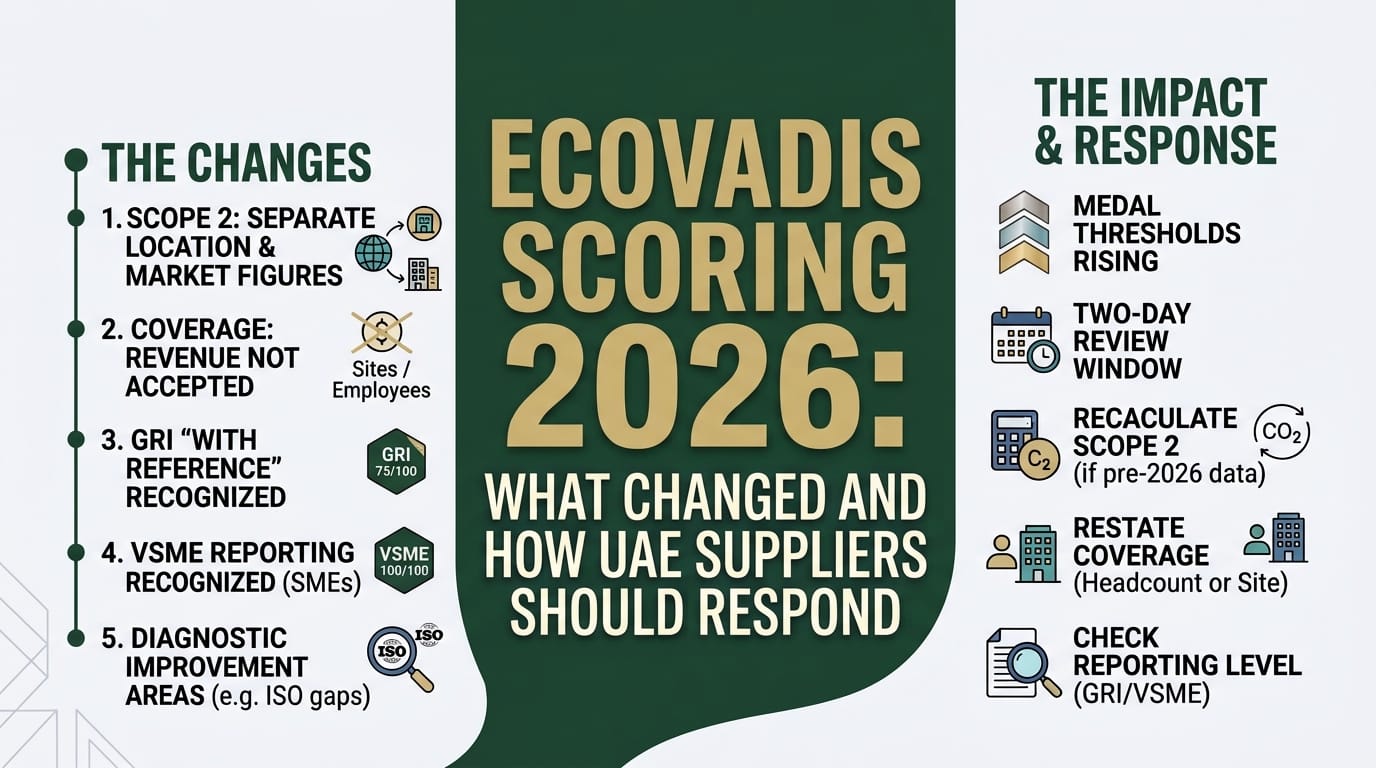
EcoVadis Scoring 2026: What Changed and How UAE Suppliers Should Respond By Danushka Prabhad, Senior...

How Amazon Sellers Can Earn the Carbon Impact Badge — And Why a Product Carbon...

Why ISO Certificates Are the Fastest Way to Improve Your EcoVadis Score By Danushka Prabhad,...
UAE GHG Reporting: What Businesses Must Do Before the Deadline By Danushka Prabhad, Senior Sustainability...

GHG Reporting in Abu Dhabi: The Complete MRV Guide Under UAE Federal Law No. 11...

How EPDs, LCA, and FSC Certified Wood Help Achieve LEED and BREEAM Credits By Danushka...

How to Register Your Company on EcoVadis (Step-by-Step Guide) Learn how to register your company...

ISO 14019: What You Need to Know About the New Sustainability Verification Standard If you’ve...

How to Read an EPD: A Practical Guide for Construction Professionals Why EPDs Are Often...

Everything You Need to Know About EPDs: All Questions Answered Home Everything You Need to...

Case Study 2 Home How Planet First Helped a Market Intelligence Firm Improve Its EcoVadis...

EPD Program Operators: How to Choose, Credibility, and Global Overview If you’re a UAE business...
Boost Your Sustainbaility performance with Expert Help
Work with Planet First, trusted sustainability consultants in the Middle East, and ensure your sustainability performance is fully recognized.
info@theplanetfirst.org
Phone
+971 50 25 35 594

A sustainability consultancy supporting ESG reporting, carbon footprint calculations, and compliance for businesses.
Main Services
Industry & Regional Services
Contact
- 112, Normandy 2, Al Nadha 2, Dubai, UAE
- info@theplanetfirst.org
- +971 50 253 5594