Why ISO Certificates Are the Fastest Way to Improve Your EcoVadis Score
By Danushka Prabhad, Senior Sustainability Consultant | Published May 2026
Introduction
Over the past several years working with companies across the UAE, GCC, and wider MENA region on their EcoVadis assessments, I’ve seen one pattern repeat itself more times than I can count — companies stuck at the same score, year after year, wondering why nothing is moving. They answer the questionnaire carefully, they submit their documents, and yet the needle barely shifts.
When I dig into their scorecards, the missing piece is almost always the same: no certifications.
Let me explain why that matters — and what you can do about it right now.
How EcoVadis Actually Works
Before we talk about certificates, it helps to understand what EcoVadis is actually measuring. EcoVadis is built on the principles of ISO 26000 — the international standard for social responsibility. That’s not a coincidence. ISO 26000 defines the core themes of responsible business, and EcoVadis has structured its entire assessment framework around those same themes.
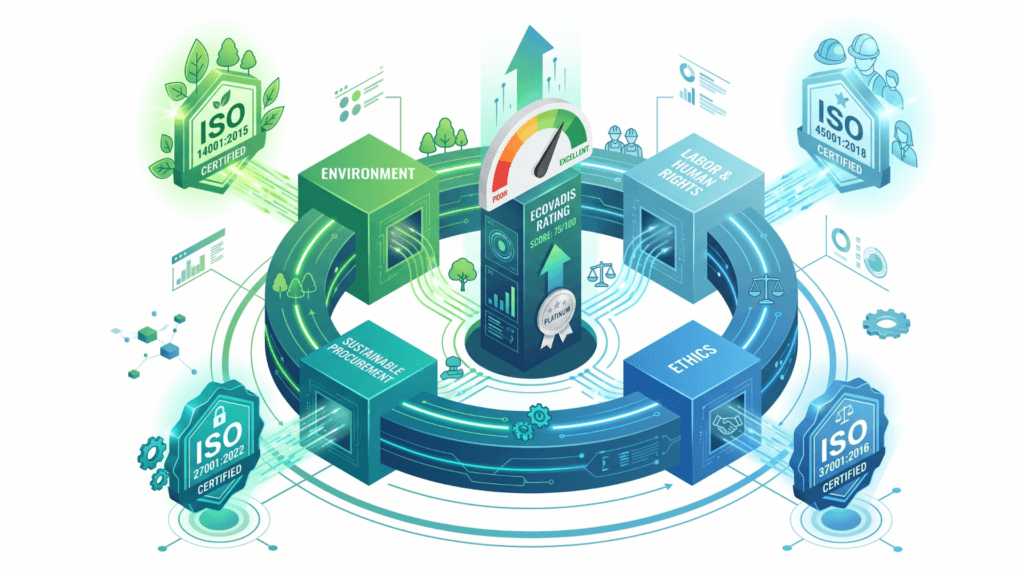
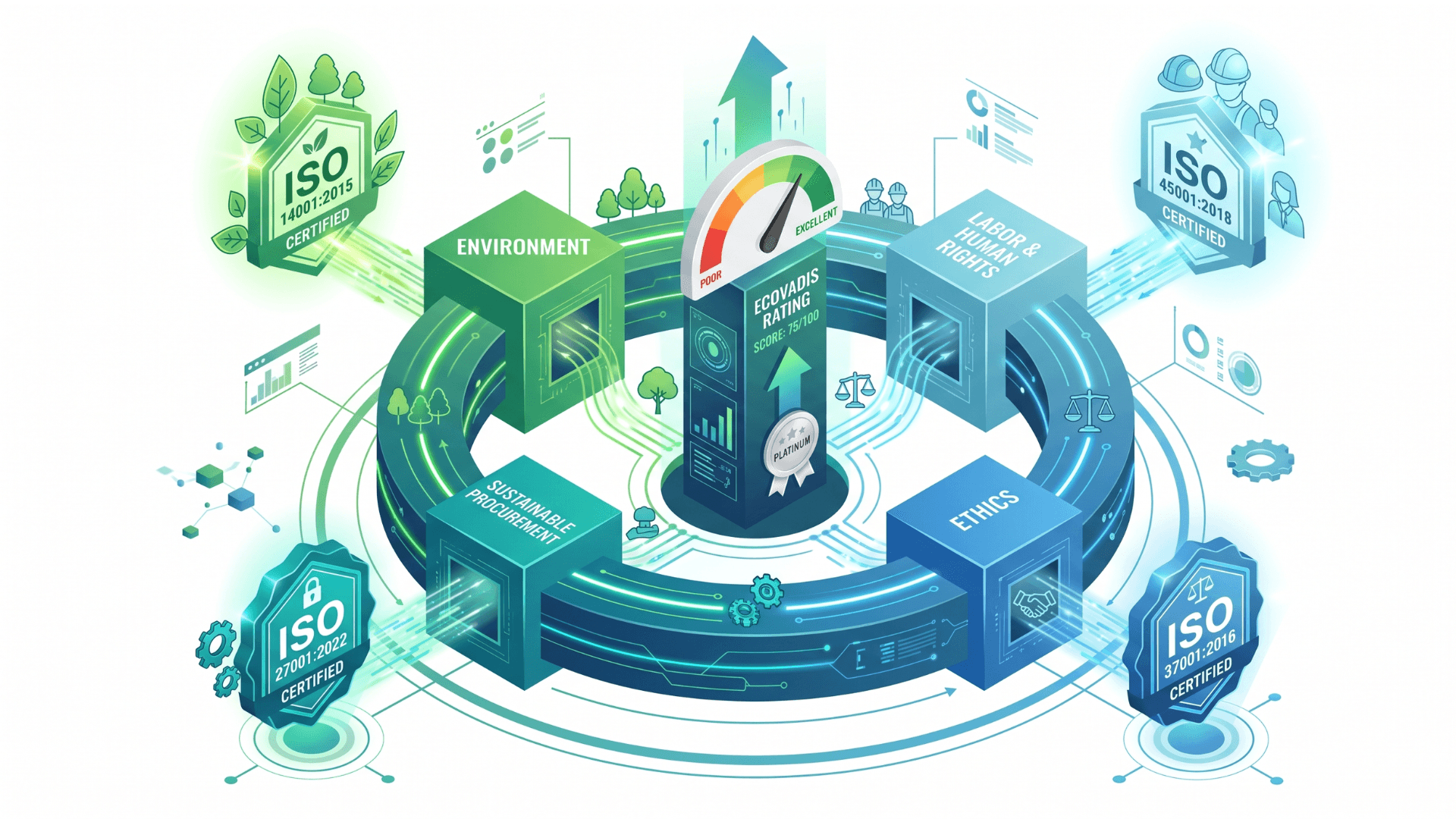
The EcoVadis scorecard evaluates your company across four categories:
- Environment
- Labor & Human Rights
- Ethics
- Sustainable Procurement
Each category is scored based on three things: the policies you have in place, the actions you’ve implemented, and the results you can demonstrate. Here’s where certifications change everything — a third-party certificate is one of the strongest forms of evidence you can provide across all three dimensions at once.
The Certificate Advantage: Category by Category
Environment
This is where I see the biggest gap for most companies. If your business does not hold ISO 14001 (Environmental Management System), you are almost certainly leaving points on the table. ISO 14001 demonstrates that your organization has a structured, audited approach to managing environmental impacts — energy use, emissions, waste, water. EcoVadis rewards this directly.
Beyond ISO 14001, depending on your industry, ISO 50001 (Energy Management) adds another layer. For companies in manufacturing or logistics here in the UAE and Gulf region, this is particularly relevant given the focus on carbon reduction and the UAE’s Net Zero 2050 commitments.
Labor & Human Rights
This category trips up many businesses, especially those operating across complex supply chains. ISO 45001 (Occupational Health & Safety Management) is the anchor certificate here. It shows your workforce safety isn’t just a policy on paper — it’s a managed, verified system.
SA8000 is another strong credential in this space, particularly respected for social accountability. If your operations involve shift workers, migrant labor, or third-party contractors — which is common in the UAE — holding SA8000 or working toward it sends a very clear signal to EcoVadis evaluators.
Ethics
Ethics is one of the most underestimated categories in the EcoVadis assessment. Companies often treat it as a compliance checkbox, but EcoVadis looks for genuine anti-corruption measures, data protection practices, and responsible business conduct.
Two certificates matter enormously here:
- ISO 37001 — Anti-Bribery Management System. This is still relatively rare in the region, which means companies that hold it stand out immediately.
- ISO 27001 — Information Security Management System. As data privacy regulations tighten across the Gulf (including the UAE’s PDPL), this certificate demonstrates that your organization manages information ethically and securely — something EcoVadis increasingly looks for in the Ethics category.
Sustainable Procurement
This is the category where supply chain transparency is everything. If your company works with timber, wood products, paper, or similar materials, FSC certification (Forest Stewardship Council) is a direct, recognized signal of responsible sourcing.
For broader supply chain standards, ISO 20400 (Sustainable Procurement) and ISO 28000 (Supply Chain Security Management) are increasingly recognized as evidence of a systematic approach to responsible sourcing. If you’re in logistics, construction, or manufacturing and you’re asking how to improve EcoVadis score in procurement, these are where I’d start.
"But We Already Have a Management System — Why Isn't the Score Moving?"
This is the most common question I get from clients in Dubai and across the UAE. The answer is usually one of two things:
First — you have internal procedures, but they haven’t been formally certified by an accredited body. EcoVadis puts significantly more weight on externally verified evidence. An internal policy alone rarely moves the score the way a certificate does.
Second — you have the certificate, but you’re not positioning it correctly in your submission. The way you present evidence in EcoVadis matters. The certificate needs to be paired with the right policies and supporting documentation in the right category.