
EPD Program Operators: How to Choose, Credibility, and Global Overview

If you’re a UAE business seeking to demonstrate environmental transparency, you’ve likely encountered Environmental Product Declarations (EPDs). These standardized documents communicate product environmental impact based on Life Cycle Assessment (LCA) data, and they’re increasingly demanded by green building projects and sustainability-conscious customers across Dubai and the Gulf region.
But here’s what many companies discover too late: not all EPDs carry equal weight. The credibility of your Environmental Product Declaration depends heavily on which EPD program operator you choose. Select the wrong operator, and your EPD might not be recognized in key markets. Choose wisely, and your verified EPD becomes a powerful competitive tool.
For businesses navigating sustainability reporting UAE requirements in 2025-2026, understanding EPD program operators isn’t optional—it’s essential.
What Is an EPD Program Operator?
An EPD program operator manages the development, verification, and registration of Environmental Product Declarations. They ensure EPDs meet ISO 14025 standards and maintain registries of published declarations.
Program operators establish Product Category Rules (PCRs)—specific methodologies for conducting LCA consultancy for particular product categories. They coordinate independent third-party verification, publish verified EPDs in accessible databases, and ensure ongoing compliance with international standards.
For UAE companies, your chosen program operator affects whether your EPD will be recognized by LEED, BREEAM, Estidama, or other green building programs—directly impacting market access.
Global Overview of Major EPD Program Operators
International EPD System (Sweden)
The world’s largest program operator, with over 2,500 published EPDs representing approximately 40% of all global declarations. It covers virtually all product categories and is recognized across Europe, North America, the Middle East, and Asia. For Dubai-based manufacturers serving international markets, this operator typically offers the broadest acceptance.
IBU – Institut Bauen und Umwelt (Germany)
IBU operates the German EPD program, focused primarily on construction products. With approximately 1,000 published EPDs (roughly 15% globally), IBU holds particular strength in European construction markets. UAE construction product manufacturers targeting Europe often find IBU registration strategically valuable.
UL Environment (USA)
Serving primarily North American markets with around 500 published declarations (approximately 8% globally). For UAE businesses with North American customers—common in aluminum, aggregates, or specialized construction materials—UL Environment ensures market access.
EPD Australasia
Serving Australia, New Zealand, and the Asia-Pacific region with approximately 300 registered EPDs (about 5% globally). Given GCC trade connections to Asian markets, this operator offers relevance for regional supply chains.
Other Notable Operators
The remaining roughly 30% of global EPDs are distributed across regional or sector-specific programs including RTS (Sweden), ECO EPD (Turkey), AENOR (Spain), BRE (UK), and ASTM International (USA).
Assessing Program Operator Credibility
ISO 14025 Compliance
Legitimate program operators must comply with ISO 14025, the international standard for Type III environmental declarations. Always verify explicit ISO 14025 compliance—this isn’t negotiable for credible EPD registration.
ECO Platform Membership
ECO Platform is a European initiative that mutually recognizes EPD programs meeting stringent quality criteria. Members undergo regular audits ensuring high standards for PCR development, verification processes, and data quality.
Major ECO Platform members include the International EPD System, IBU, INIES (France), EPD Norge (Norway), and RTS. ECO Platform membership signals that EPDs will be recognized across European green building schemes—critical for UAE exporters serving European markets.
Verification Process Rigor
Credible operators require independent third-party verification by qualified verifiers. Check whether the program operator:
- Maintains a network of approved verifiers with relevant expertise
- Requires verifier independence from LCA practitioners
- Provides clear verification protocols and reviewer qualifications
- Publishes verification statements with each EPD
International Recognition
The best program operator depends on your target markets. Research whether EPDs are accepted by:
- Green building certifications in key markets (LEED, BREEAM, Estidama, GSAS)
- Major customers or procurement frameworks you serve
- Industry-specific sustainability programs
For UAE businesses serving diverse international markets, operators with broad recognition like the International EPD System typically offer the safest choice.
Transparency and Accessibility
Reputable operators maintain publicly accessible databases. Verify that the operator:
- Publishes EPDs in searchable online databases
- Provides EPDs in multiple languages where relevant
- Makes PCRs freely available
- Maintains clear program documentation
Choosing the Right Operator for Your UAE Business
Geographic Market Alignment
If you primarily serve GCC and Middle East markets, ensure chosen operators’ EPDs are recognized by regional green building programs. Estidama, LEED (extensively used across UAE and Saudi Arabia), and QSAS all accept EPDs from major international operators.
For businesses with European export markets—common in UAE aluminum, stone, and specialty construction—prioritize operators with ECO Platform membership.
Product Category Expertise
Check whether your product category has established PCRs with target operators. Developing new PCRs adds time and cost. Major operators like the International EPD System have PCRs for hundreds of categories, while specialized operators may offer deeper sector expertise.
Cost and Timeline
EPD registration costs typically range from €2,000-€5,000 (excluding LCA consultancy Dubai and verification costs). Timelines from LCA completion to verified EPD publication usually span 3-6 months. For time-sensitive projects, confirm typical processing times before committing.
Long-Term Strategic Value
EPDs typically remain valid for five years with renewal options. Choose operators with demonstrated stability and growing market recognition rather than selecting purely on lowest cost.
Practical Steps for Dubai and UAE Businesses
Conduct LCA:
Complete Life Cycle Assessment following ISO 14040/14044 standards through internal expertise or experienced LCA consultancy UAE providers.Identify Relevant PCRs:
Research which operators have Product Category Rules matching your product.Assess Market Requirements:
Consult key customers and green building consultants about which program operators they recognize.Select Program Operator:
Based on market alignment and credibility assessment, choose your operator and initiate registration.Arrange Verification:
Engage an approved third-party verifier through your chosen operator.Register and Publish:
Submit verified documentation, pay fees, and receive your published Environmental Product Declaration 2025-2026.Leverage Your EPD:
Integrate verified EPDs into marketing, specifications, and sustainability reporting UAE efforts.
Why EPD Credibility Matters in 2025-2026
Environmental claims scrutiny has intensified globally. Greenwashing regulations demand substantiation. A verified EPD from a credible program operator provides defensible, third-party validated environmental information.
For UAE businesses competing internationally or serving sustainability-focused customers, EPD credibility directly affects market access. Major construction projects now routinely specify products with verified EPDs. Procurement frameworks increasingly mandate environmental transparency.
How Planet First Consultants Support Your EPD Journey
Navigating EPD complexities—from initial LCA through program operator selection to verified registration—requires specialized expertise most UAE businesses don’t possess internally.
Planet First Consultants provides comprehensive EPD consultancy Dubai services:
LCA Consultancy UAE:
We conduct rigorous Life Cycle Assessments following ISO standards, ensuring environmental data meets operator and verifier requirements.
Program Operator Selection:
We evaluate operators based on your market requirements, product categories, and strategic objectives.
PCR Navigation:
We identify appropriate Product Category Rules or support new PCR development.
Verification Coordination:
We liaise with third-party verifiers, address technical questions, and streamline verification.
Registration Management:
We handle EPD registration complexities, ensuring accurate documentation and timely publication.
Strategic Integration:
We help leverage your Environmental Product Declaration in marketing, sustainability reporting, and customer communications.
Our team combines technical LCA expertise with practical understanding of UAE business contexts, regional requirements, and international frameworks. We’ve supported manufacturers across construction materials, packaging, aluminum, and industrial products in achieving verified EPDs recognized by major green building programs.
Conclusion
Environmental Product Declarations represent powerful tools for demonstrating transparency and accessing sustainability-focused markets. But EPD credibility depends on choosing the right program operator.
For Dubai and UAE businesses pursuing verified EPDs in 2025-2026, prioritize operators with ISO 14025 compliance, ECO Platform recognition where relevant, rigorous verification, and strong acceptance in target markets. The International EPD System offers broad international recognition, while specialized operators may provide sector-specific advantages.
Strategic program operator selection requires understanding both technical requirements and market dynamics—expertise most businesses develop only after costly mistakes.
Ready to develop a verified EPD that opens doors in your target markets?
Contact Planet First Consultants for expert EPD and LCA consultancy tailored to UAE businesses. We’ll guide you through program operator selection, conduct rigorous assessment, coordinate verification, and deliver credible Environmental Product Declarations that strengthen your competitive position.
Email us at info@theplanetfirst.org or schedule a consultation to discuss your EPD registration needs.
Transform environmental transparency from compliance requirement into competitive advantage.
Understanding the EcoVadis Document Limit
EcoVadis is the leading supplier sustainability assessment platform, evaluating companies across Environment, Labour & Human Rights, Ethics, and Sustainable Procurement. Over 100,000 companies worldwide are now rated, with major buyers requiring suppliers to achieve minimum scores.
The 55-document limit applies to your entire assessment—not per section or question, but total. EcoVadis designed this cap to ensure fairness. Without limits, large corporations could submit 500 documents while smaller suppliers provide 20, creating uneven evaluation standards.
For analysts reviewing assessments, 55 documents represents substantial work. The limit keeps evaluations manageable while forcing all companies to prioritize evidence strategically rather than dumping every file they have.
But here’s the problem: most medium and large organizations have far more than 55 relevant sustainability documents. The constraint forces difficult choices about what to submit and how to combine materials.
Why Documents Get Rejected Before Content Review
Successfully uploading a document doesn’t guarantee it’ll be evaluated. EcoVadis analysts conduct pre-screening to determine if evidence is actually usable:
- Does this document relate to the specific question?
- Can I understand what this is and why it’s submitted?
- Does it cover the right organizational scope?
- Can I navigate this file efficiently?
- Is this legitimate, verifiable documentation?
Documents failing these basic checks get marked “not considered” without content evaluation. Your score drops not because your sustainability practices are weak, but because your evidence presentation failed.
Common rejection triggers:
Random document combinations confuse analysts. Merging your Code of Conduct, Environmental Policy, and Supplier Evaluation into one PDF because they’re all “important documents” creates navigation nightmares. Analysts won’t hunt through 80 pages of mixed content to find relevant sections.
Oversized compilation files without structure become unusable. A 200-page PDF combining dozens of unrelated documents with no table of contents gets minimal attention, regardless of content quality.
Unclear file names like “Combined_Final_v2.pdf” tell analysts nothing. They won’t spend time figuring out mystery documents when dozens of other assessments need review.
Multi-year data without clear labels makes performance metrics uninterpretable. If analysts can’t identify which numbers represent current performance versus historical data, the evidence becomes unreliable.
Smart Document Combination Strategies
Strategic consolidation is necessary—just do it thoughtfully:
Annual sustainability reports work exceptionally well. A professionally structured ESG report with clear sections, table of contents, and organized data can address multiple EcoVadis questions across different themes while using just one document slot. Analysts appreciate coherent sustainability narratives over disconnected policy fragments.
Integrated management system manuals make sense. If you genuinely operate with integrated ISO systems (quality + environmental + safety), submitting combined documentation reflects reality. Just ensure it’s actually how you operate, not forced integration solely for EcoVadis.
Policies paired with implementing procedures show complete pictures. Combining your Environmental Policy with Waste Management and Emergency Response Procedures demonstrates both commitment and implementation methodology—exactly what EcoVadis values.
Evidence portfolios with clear organization work when structured properly. Training programs combining policies, schedules, materials, and completion records tell coherent stories. Just include index pages, section headers, and clear navigation.
Document Combinations That Consistently Fail
Mixing unrelated policies. Throwing together environmental, ethics, and procurement policies because they’re all “policies” creates thematic confusion. Analysts reviewing environmental questions won’t dig through ethics content to find relevant sections.
Multi-year data mashups without clarity. Combining 2022, 2023, and 2024 performance metrics in spreadsheets without explicit year labels prevents analysts from understanding current performance—the primary EcoVadis focus.
Everything-in-one-file approaches. Creating 150-page documents containing every possible piece of evidence signals poor prioritization. These get skimmed at best, ignored at worst.
Unsearchable scanned images. PDFs without OCR (optical character recognition) can’t be text-searched, forcing manual review of every page. In practice, analysts often skip these entirely.
Practical Tips from Assessment Experience
Think like a time-pressured analyst. They’re reviewing dozens of assessments simultaneously. Documentation that facilitates quick, efficient review gets thorough evaluation. Files requiring extensive navigation get minimal attention.
Prioritize implementation proof over policy statements. EcoVadis scoring favors evidence of actual practices—training records, audit reports, performance data—more than policy commitments. When document limits force choices, always choose operational evidence.
Use strategic file naming. “Environmental_Performance_2024_Energy_Water_Waste.pdf” communicates content immediately. Generic names provide zero context and waste analyst time.
Build visual navigation into combined documents. Cover pages, section headers, and tables of contents aren’t decorative—they’re functional tools that help analysts locate information fast, improving evaluation quality.
Test your documents before submission. Have someone unfamiliar with your assessment try finding specific information in your combined files. If they struggle, fix the structure before uploading.
When to Seek External EcoVadis Support
The document limitation challenge disproportionately affects:
- Medium and large companies (500+ employees) with extensive documentation across departments and facilities
- Organizations with complex operations—multiple sites, diverse geographies, varied business units
- Companies pursuing Gold or Platinum recognition where evidence presentation quality becomes as critical as program substance
- Businesses recovering from disappointing initial scores where document strategy errors may have prevented proper evaluation
Consultants bring specialized knowledge of how EcoVadis analysts evaluate documentation, which evidence combinations work reliably, and how to prioritize within constraints. This expertise typically costs less than multiple reassessment cycles spent learning through trial and error.
Final Thoughts
The EcoVadis 55-document limit forces strategic thinking about evidence presentation. Success requires understanding that documents must survive pre-screening before content evaluation occurs.
Companies achieving strong ratings aren’t always those with the most extensive documentation—they’re organizations thinking strategically about evidence selection, prioritizing implementation proof over policies, and presenting documentation analysts can actually evaluate efficiently.
Before your next EcoVadis assessment, invest serious time in document strategy with the same rigor you apply to sustainability program implementation. Your scorecard depends on it.
Need help navigating EcoVadis document strategy? At Planet First, our trained and certified EcoVadis consultants have guided dozens of UAE and GCC companies through successful assessments. We know exactly which document combinations pass pre-screening and which get rejected—because we’ve seen both outcomes repeatedly. Whether you’re facing your first assessment with tight customer deadlines, recovering from a disappointing score, or pursuing Gold recognition, we help you prioritize evidence strategically, structure submissions properly, and avoid the document rejection traps that cost points before scoring begins. Get in touch at info@theplanetfirst.org for a practical assessment of your documentation readiness.
- All Posts
- blog
- Cases

How Amazon Sellers Can Earn the Carbon Impact Badge — And Why a Product Carbon...
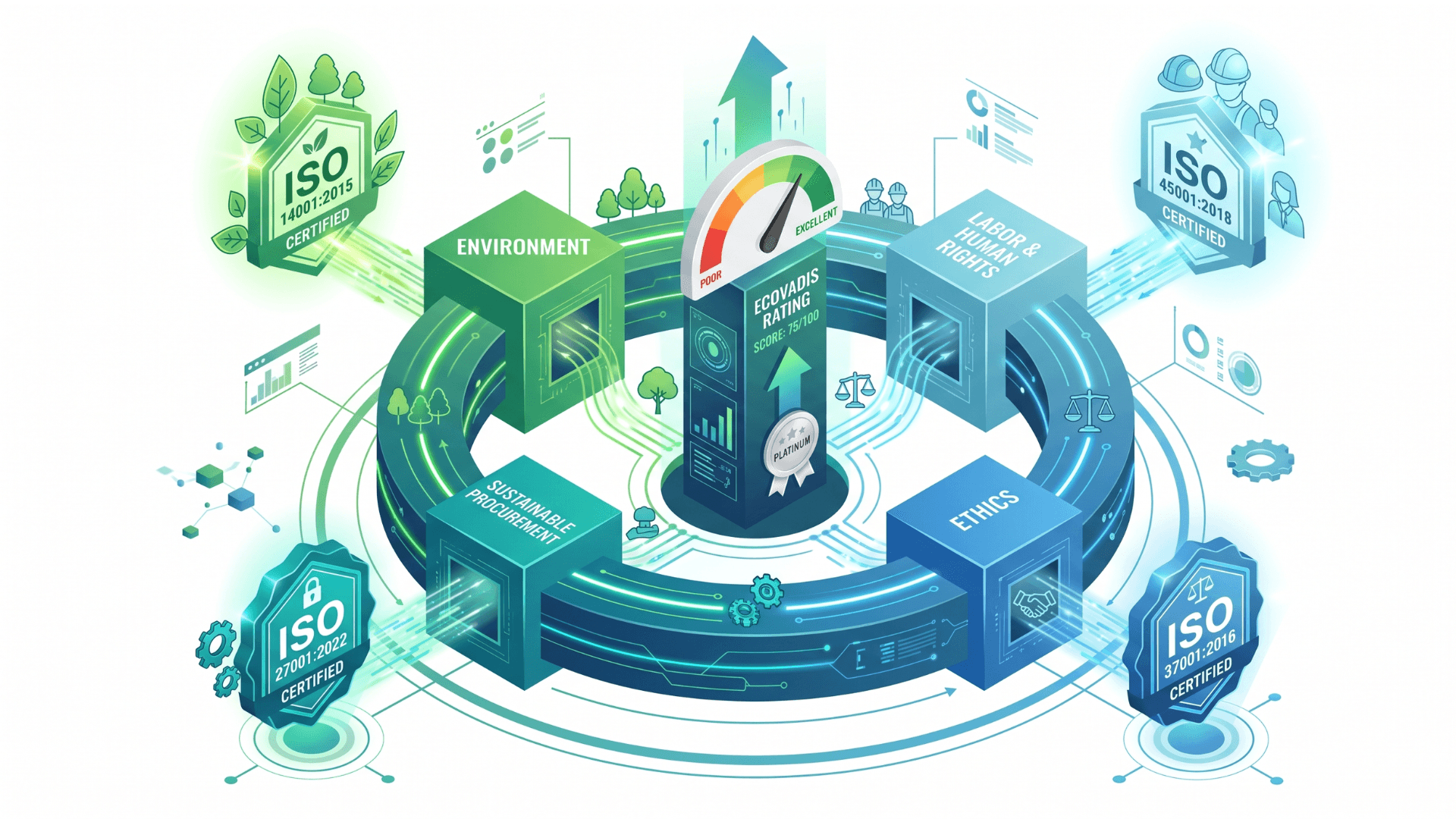
Why ISO Certificates Are the Fastest Way to Improve Your EcoVadis Score By Danushka Prabhad,...

UAE GHG Reporting: What Businesses Must Do Before the Deadline By Danushka Prabhad, Senior Sustainability...

GHG Reporting in Abu Dhabi: The Complete MRV Guide Under UAE Federal Law No. 11...

How EPDs, LCA, and FSC Certified Wood Help Achieve LEED and BREEAM Credits By Danushka...

How to Register Your Company on EcoVadis (Step-by-Step Guide) Learn how to register your company...

ISO 14019: What You Need to Know About the New Sustainability Verification Standard If you’ve...

How to Read an EPD: A Practical Guide for Construction Professionals Why EPDs Are Often...

Everything You Need to Know About EPDs: All Questions Answered Home Everything You Need to...

Case Study 2 Home How Planet First Helped a Market Intelligence Firm Improve Its EcoVadis...

EPD Program Operators: How to Choose, Credibility, and Global Overview If you’re a UAE business...

Why Companies Fail EcoVadis Before Scoring Even Starts: The 55-Document Trap You’ve gathered everything—environmental policies,...
Boost Your Sustainability Performance with Expert Help
Work with Planet First, the trusted Sustainbility consultants in the Middle East, and ensure your sustainability performance is fully recognized.
info@theplanetfirst.org
Phone
+971 50 25 35 594

A sustainability consultancy supporting ESG reporting, carbon footprint calculations, and compliance for businesses.
Main Services
Industry & Regional Services
Contact
- 112, Normandy 2, Al Nadha 2, Dubai, UAE
- info@theplanetfirst.org
- +971 50 253 5594