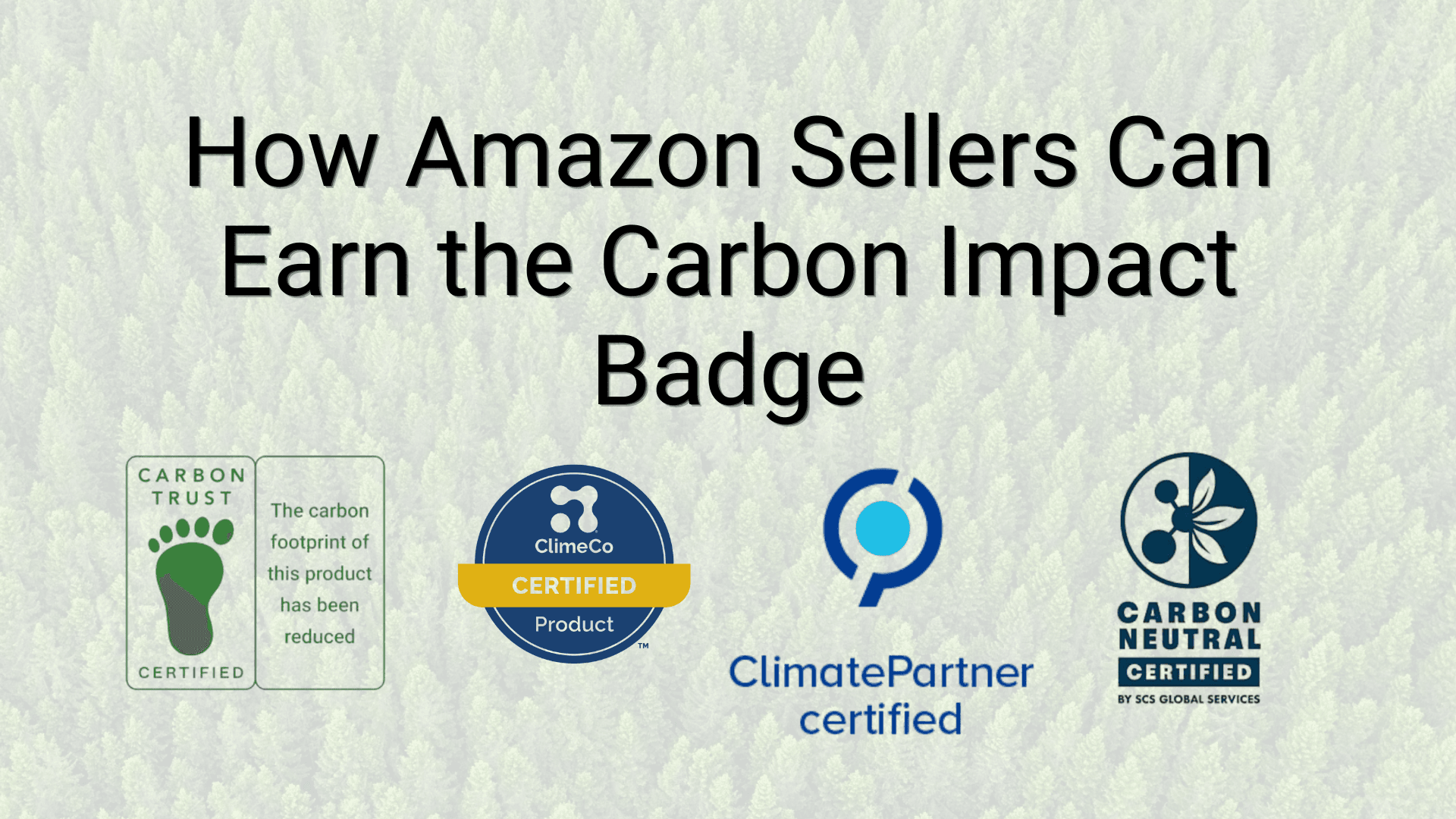
Different certifying bodies. Different methodologies. Different geographies. But every single certification listed above shares one requirement: you must first calculate your product carbon footprint.
Before ClimeCo can review your application, you need a PCF report. Before Carbon Trust can issue a Reducing CO₂ label, you need a measured and verified carbon footprint. Before CarbonNeutral can offset your product’s emissions, they need to know what those emissions are.
The PCF report is not optional — it is the foundation. Without it, none of these certification pathways can begin.
This is where many Amazon sellers get stuck. They understand the commercial value of the Carbon Impact badge, they’ve chosen a certification body, but they don’t know how to produce a PCF report that will actually be accepted. A PCF prepared without the right methodology, system boundaries, or data quality will be rejected or sent back for revision — costing time and delaying the certification that could be boosting their sales.
What Makes a Good Product Carbon Footprint Report?
A credible PCF report — the kind that will satisfy ClimeCo, Carbon Trust, ClimatePartner, or any other Amazon-approved certifier — is built on internationally recognised standards. The most widely accepted is ISO 14067:2018, which specifies the principles, requirements, and guidelines for quantifying the carbon footprint of a product.
A quality PCF report will typically include:
- Clearly defined system boundary — specifying which lifecycle stages are included (cradle-to-gate, or ideally cradle-to-grave for consumer products)
- Functional unit — the unit of measurement against which all emissions are expressed (e.g., per unit sold, per kilogram of product)
- Life cycle inventory (LCI) — a complete accounting of all materials, energy inputs, transport, and processes across the product’s lifecycle
- Emission factor selection — using recognised databases such as Ecoinvent, GaBi, or government-published GHG conversion factors, with full traceability
- Sensitivity analysis — testing the robustness of results against key assumptions
- Third-party review readiness — structured in a format that can be submitted directly to the certifying body
The methodology matters. A PCF report prepared for internal use is structured differently from one prepared for external certification. If you intend to use it for Amazon’s Carbon Impact badge, it needs to be built to certification standards from the start.
The Carbon Impact badge is relevant for any Amazon seller whose product involves manufacturing, materials, or supply chain processes — which is virtually everyone selling a physical product. But it’s particularly timely for:
- Sellers in competitive categories — electronics, personal care, home goods, apparel — where differentiation is difficult and the Carbon Impact badge provides a genuine visual edge in search results
- Brands selling across Amazon’s global marketplaces — the Climate Pledge Friendly program operates across 14 Amazon marketplaces including the US, UK, Germany, France, Japan, and Australia, meaning one certification can unlock the badge globally
- Sellers supplying to corporate or B2B buyers on Amazon Business — institutions with sustainability procurement policies actively filter for Climate Pledge Friendly products
- Manufacturers who have already made sustainability improvements — if you’ve already switched to renewable energy, reduced packaging, or improved your supply chain efficiency, a PCF report may reveal a reduction trajectory that qualifies you for Carbon Trust or GreenCircle certification sooner than you think
The Carbon Impact badge is not a compliance exercise. It is a sales tool.
Amazon’s own data shows that Climate Pledge Friendly products see an average 12% sales lift and 10% more product views within the first year of earning the badge. With Amazon’s algorithm actively promoting CPF-badged products and customers filtering specifically for them, the badge changes where your product appears in search — before a single ad spend.
Nearly 37.6 million Amazon customers switched to Climate Pledge Friendly products in 2023 alone, representing 42% year-on-year growth in CPF shopping behaviour. That is not a niche audience. It is a mainstream and rapidly expanding segment of Amazon’s customer base.
The cost of a professionally prepared PCF report, followed by certification, is typically recovered within months through increased sales velocity — and the certification, once earned, supports multiple commercial uses beyond Amazon, including ESG reporting, supply chain disclosures, and brand marketing.
How Planet First Can Help
At Planet First, we provide product carbon footprint (PCF) calculations and life cycle assessments built to the standards required by Amazon’s approved Carbon Impact certifiers — including ClimeCo, Carbon Trust, ClimatePartner, and CarbonNeutral.
We are a technically rigorous sustainability consultancy with deep expertise in ISO 14067, GHG Protocol, and ISO 14040/44 methodologies. Our PCF reports are structured for certification submission from day one — not generic assessments that need to be reworked when you apply to a certifier.
We work with product sellers, manufacturers, and brands globally. Whether you’re based in the United States, United Kingdom, Europe, the Middle East, or Asia-Pacific, and whether you sell on Amazon.com, Amazon.co.uk, Amazon.de, or any of Amazon’s 14 supported marketplaces, we can deliver a PCF report that puts you on the path to the Carbon Impact badge.
Our process is straightforward:
- Scoping call — we understand your product, supply chain, and which Carbon Impact certification makes most sense for your goals
- Data collection — we guide you through gathering the materials, energy, and logistics data needed for the LCA
- PCF calculation — we conduct the full ISO 14067-aligned carbon footprint calculation
- Report delivery — you receive a certification-ready PCF report, formatted for submission to your chosen certifying body
Certification support — we can assist with the certifier submission process and respond to any review queries
If you’re an Amazon seller who wants the Carbon Impact badge — or simply wants to understand what your product’s carbon footprint actually is — the first step is a conversation.
Contact Planet First to discuss your product, your certification goals, and how we can get you a PCF report that opens the door to Amazon’s Carbon Impact feature.
Planet First is a sustainability consultancy delivering technically rigorous carbon footprinting, LCA, EPD, ESG reporting, and EcoVadis services to businesses globally. Our work is grounded in internationally recognised standards including ISO 14067, ISO 14040/44, GHG Protocol, and EN 15804.