If your company is preparing for an EcoVadis assessment or reassessment in 2026, relying on the evidence that worked during your previous assessment may no longer be sufficient. Changes to the EcoVadis assessment methodology have affected how certain information is presented, evidenced and evaluated.
For UAE and GCC suppliers—particularly companies in manufacturing, construction, aluminium, printing, facilities management and other supply-chain-intensive sectors—these changes make it important to review the evidence pack before submitting a new assessment.
This article summarises the key 2026 changes and highlights practical actions companies can take when preparing their next EcoVadis submission.
The overall EcoVadis assessment continues to evaluate a company’s sustainability management system through the four core areas of Policies, Actions, Results and 360° Watch.
However, changes to methodology and evidence requirements can affect how a company’s existing sustainability practices are reflected in its scorecard.
This means that a company can maintain broadly similar sustainability performance while receiving different results if the evidence submitted, coverage calculations or reporting approach does not meet the current assessment expectations.
The practical priority is therefore not simply to reuse the previous evidence pack, but to review it against the methodology applicable to the current assessment cycle.
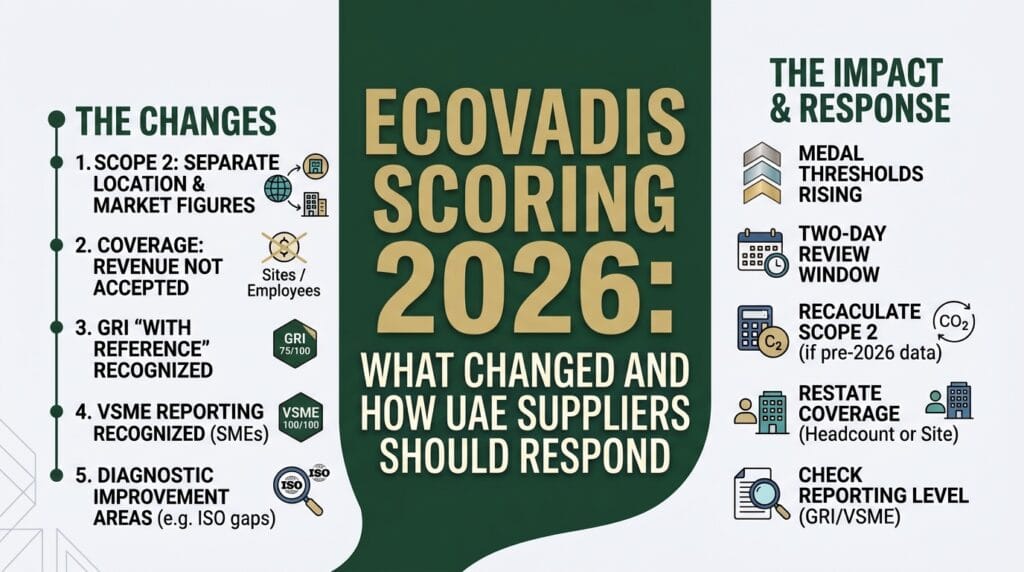
1. Scope 2 emissions: location-based and market-based reporting
One of the important areas for companies maintaining a GHG inventory is the treatment of Scope 2 emissions.
Companies reporting Scope 2 emissions should distinguish between:
- Location-based Scope 2 emissions
- Market-based Scope 2 emissions
This distinction follows the GHG Protocol’s approach to Scope 2 accounting.
For many UAE companies purchasing electricity from the local grid, the two results may be similar where no contractual instruments or renewable electricity arrangements affect the market-based calculation. However, they should still be calculated and documented using the appropriate methodology rather than presenting only a single undifferentiated Scope 2 figure.
What UAE companies should do
If your previous GHG inventory reported only one Scope 2 figure, review the calculation before your next EcoVadis submission.
Maintain supporting evidence such as:
- Electricity consumption records
- Utility bills
- Emission-factor sources
- Scope 2 calculation worksheets
- Renewable electricity or contractual instrument documentation, where applicable
- A documented GHG calculation methodology
For companies reporting Scope 1 and Scope 2 emissions, it is also important to ensure that the reporting period, organisational boundary and calculation methodology are clearly documented.
2. Coverage should be supported by measurable organisational data
Coverage is an important part of demonstrating that sustainability policies, procedures and contractual requirements apply across the relevant organisation or supply chain.
Where coverage thresholds are required, companies should be careful about relying on revenue as the only measure of coverage.
For many UAE organisations, employee numbers and site numbers provide more transparent evidence of organisational coverage.
For example, instead of stating:
“The policy covers sites representing 85% of group revenue.”
a company may be able to demonstrate coverage through:
- Percentage of employees covered
- Number or percentage of operational sites covered
- Percentage of relevant suppliers covered
- Employee or site registers supporting the calculation
Recommended evidence
Keep the supporting calculation together with the relevant policy or procedure.
For example:
Supplier Code of Conduct → Coverage Statement → Supplier Register → Coverage Calculation
This creates a much stronger evidence trail than a percentage stated within a policy without supporting documentation.
3. Sustainability reporting: review GRI applicability
Sustainability reporting continues to provide an important source of Results and reporting evidence for EcoVadis assessments.
Companies using the Global Reporting Initiative (GRI) framework should review which reporting approach they use and whether the resulting report satisfies the current EcoVadis evidence requirements.
For organisations that already prepare sustainability information but do not have the resources to produce a comprehensive report, a proportionate reporting approach may be more practical.
The important point is to ensure that the published report contains meaningful, company-specific information rather than simply referencing a reporting framework.
A useful sustainability report should, where applicable, include:
- Environmental performance
- GHG emissions
- Energy consumption
- Water consumption
- Waste
- Employee and social indicators
- Ethics and compliance
- Sustainability objectives and targets
- Progress against previous targets
4. VSME can provide a practical reporting route for SMEs
For many UAE suppliers, particularly small and medium-sized companies, preparing a full-scale sustainability report can appear disproportionate to the organisation’s size and resources.
The VSME (Voluntary Sustainability Reporting Standard for non-listed SMEs) provides a more proportionate reporting framework for smaller organisations.
For companies considering VSME reporting, the key question is not simply whether the company has produced a report, but whether the report contains sufficient company-specific sustainability information and addresses the relevant reporting requirements.
For an SME preparing for EcoVadis, a structured VSME-based sustainability report can also help consolidate information that is otherwise scattered across separate policies, spreadsheets, utility records, GHG calculations and HR documents.
A practical approach for UAE SMEs
A company can use its sustainability report to bring together:
Policies → Objectives → Actions → KPIs → Results
This also helps create a more consistent sustainability management system for future assessment cycles.
5. Improvement Areas are becoming more specific
Another important development is the increasing level of detail provided through EcoVadis scorecard feedback.
Rather than relying only on a general statement that a management system needs improvement, companies may receive more specific indications of areas where their sustainability approach could be strengthened.
These can relate to areas such as:
- Quantitative sustainability objectives
- Policy coverage
- Management actions
- Performance indicators
- Reporting
- External initiatives
- Certifications
- Industry-specific expectations
Companies should therefore treat the Improvement Areas section of their scorecard as a practical management-system improvement tool.
If an improvement area identifies a specific weakness, the appropriate response is not necessarily to obtain a certification simply because it is mentioned. Instead, the company should first determine whether the identified issue represents a genuine gap in its sustainability management system and what evidence would appropriately address it.
6. Medal thresholds should not be treated as fixed targets
EcoVadis medals are awarded using a percentile-based approach, meaning that medal thresholds can change over time as the performance of the rated population changes.
Consequently, a company should not assume that achieving the same numerical score as a previous assessment will automatically produce the same medal outcome.
This is an important distinction:
Your sustainability score and your medal are not necessarily the same thing.
Companies should therefore focus on strengthening the underlying management system and evidence rather than building their entire preparation strategy around a historical medal threshold.
7. Review your scorecard promptly
Companies should also pay attention to the review process following completion of an assessment.
When a scorecard becomes available, review the information promptly and check for factual or administrative errors.
In particular, verify:
- Company information
- Assessment scope
- Reporting periods
- Uploaded evidence
- Sustainability performance data
- Policies and management-system information
- Scorecard comments and Improvement Areas
A structured review can help identify factual discrepancies that should be raised through the applicable EcoVadis process.