UAE GHG Reporting: What Businesses Must Do Before the Deadline
By Danushka Prabhad, Senior Sustainability Consultant | Published April 2026
Introduction
If you’ve been following sustainability news in the UAE, you probably already know that climate reporting just got a lot more serious. But knowing something is coming and actually being ready for it are two very different things.
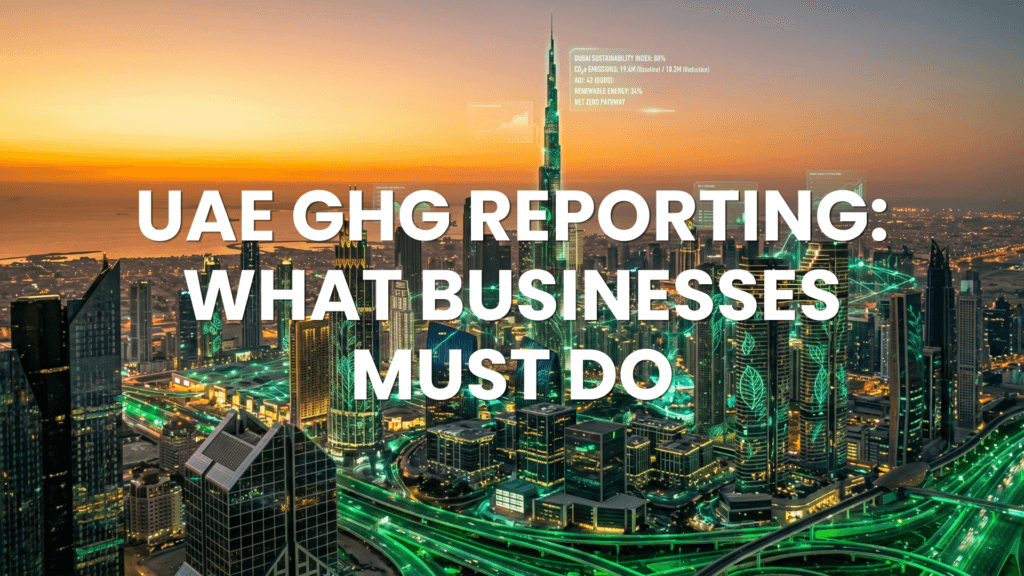
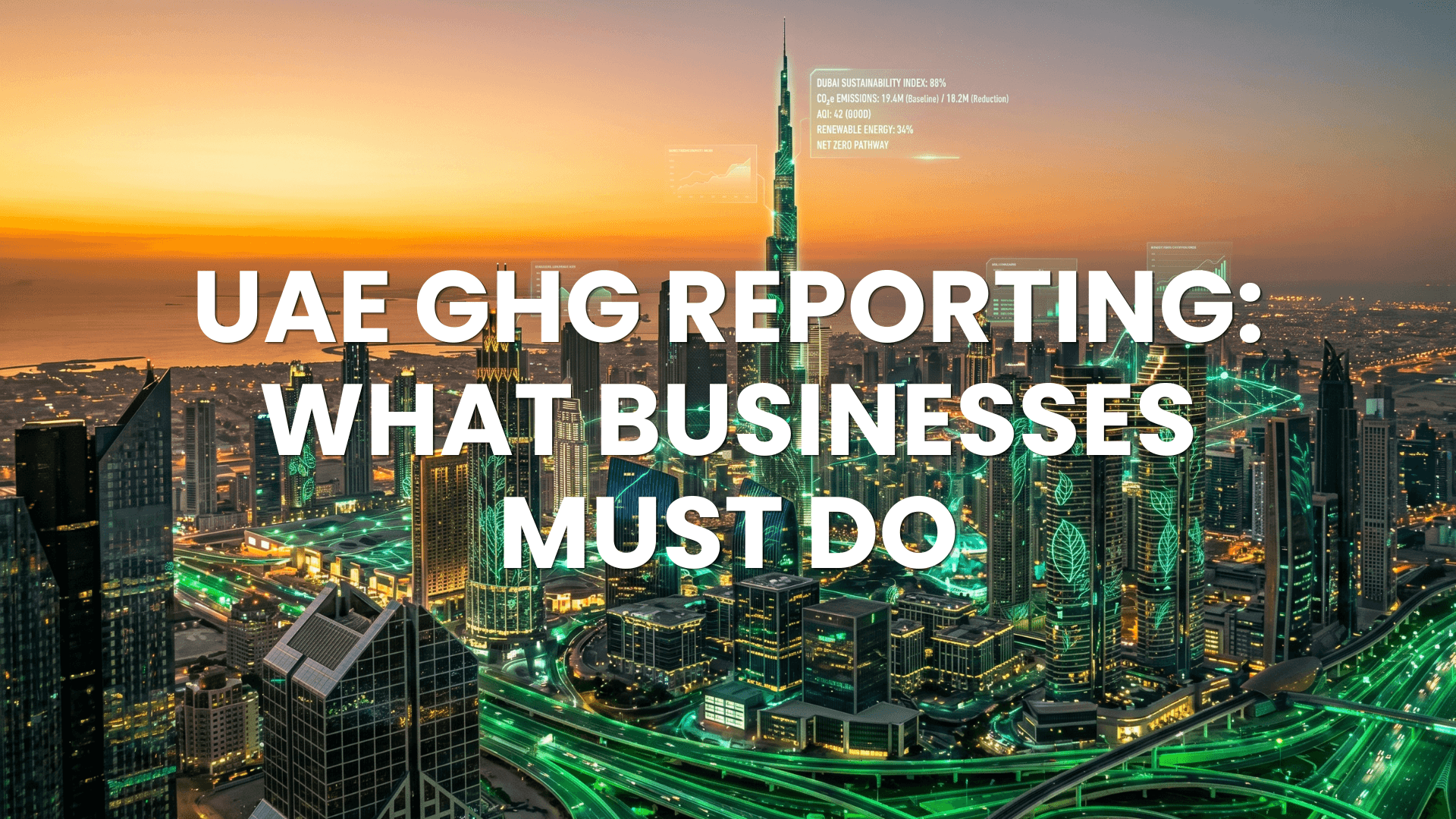
Federal Decree-Law No. 11 of 2024 on the Reduction of Climate Change Effects made greenhouse gas (GHG) reporting a formal legal obligation in the UAE. Not a recommendation. Not a voluntary ESG initiative. An actual compliance requirement — with a deadline of 30 May 2026.
That’s closer than most businesses realize.
What Changed — and Why It Matters
For years, emissions reporting in the UAE was largely driven by voluntary sustainability frameworks or pressure from international investors and supply chains. Companies that reported did so because it was good practice, not because they had to.
That era is over.
The new Climate Change Law establishes a national Measurement, Reporting, and Verification (MRV) system — a centralized digital platform launched by the Ministry of Climate Change and Environment (MOCCAE) in October 2025 — through which companies must measure, document, and submit their greenhouse gas emissions data.
Think of it like VAT registration, but for carbon. The system is live, the rules are in place, and the clock is ticking.
Who Does This Apply To?
This is one of the most common questions we get at Planet First Consultancy, and the honest answer is: the law casts a wide net.
It applies to entities operating in the UAE — including those in free zones — across both public and private sectors. If your company runs facilities, warehouses, plants, or offices in the UAE, or if your operations involve fuel consumption, electricity use, refrigerants, industrial processes, or logistics, you are very likely in scope.
The practical rule of thumb? Don’t assume you’re exempt. Check first.
Many businesses are surprised to discover they fall under the requirements — not because they’re large emitters, but because the definition of a “source” under the law is broad enough to capture most commercial operations of any meaningful size.
How the Reporting Process Actually Works
Let’s skip the jargon and walk through what this looks like in practice.
Step 1: Figure out if you're in scope
This means reviewing your legal entity structure, your UAE sites, your business activities, and what types of emissions your operations generate. For companies with multiple entities or sites, this scope review is critical — it determines whether you’re reporting one inventory or several.
Step 2: Register on the MRV platform
Once you know you’re in scope, you’ll need to register on MOCCAE’s national MRV system. Have your trade license details, operational site information, and contact persons ready before you begin.
Step 3: Collect your activity data
This is where most companies hit their first real challenge — and where the quality of your final report is won or lost. You need documented data on electricity consumption, fuel use, refrigerant top-ups, industrial process inputs, waste, and transport. If your data is scattered across departments or sitting in paper invoices, now is the time to get organized.
Step 4: Calculate your emissions
Activity data gets converted into COâ‚‚ equivalent figures using recognized emission factors and methodologies. This step requires some technical know-how — if your internal sustainability team hasn’t done this before, it’s worth getting support to make sure the numbers are consistent and defensible.
Step 5: Prepare your emissions inventory and report
This isn’t just filling in a form. Your report needs to show emission sources, calculation boundaries, totals, and supporting evidence. Crucially, the law also requires you to describe what you’re doing — or planning to do — to reduce your emissions. That narrative matters.
Step 6: Be ready for verification
The Ministry has the authority to verify your data. That means utility bills, fuel invoices, refrigerant logs, meter readings, and calculation files should all be organized and accessible. Even if external assurance isn’t mandatory in every case, being verification-ready protects you.
Step 7: Submit through the MRV platform
Final submission happens through the official system. After that, you’re required to retain all supporting records for a minimum of five years — and prepare to repeat the cycle.
The Reporting Challenges Nobody Talks About
We work with a lot of UAE businesses on their first emissions inventory, and there are patterns we see again and again.
Data is siloed. Electricity bills are with the facilities team, fuel records are with operations, and refrigerant logs — if they exist at all — are somewhere else entirely. Nobody has a complete picture.
There’s no internal owner. Sustainability reporting often falls into a gap between HR, finance, and operations. Without a clear point of accountability, things stall.
Records are incomplete. Many companies have never tracked refrigerant use or scope 3 transport emissions at all. Starting from zero is possible, but it takes time.
The emissions calculation feels abstract. Converting kilowatt-hours and liters of diesel into COâ‚‚ equivalent figures isn’t instinctive for most teams. It requires methodology decisions and careful documentation.
None of these are insurmountable. But they’re much easier to solve in early 2026 than in late April 2026.
Why Starting Now Is Worth It
There’s a practical argument and a strategic one.
The practical argument: companies that start their data collection and scope review early have time to fix gaps, clarify ambiguities, and prepare a clean submission. Companies that wait until Q1 2026 are often scrambling — and scrambling tends to produce weak reports.
The strategic argument: going through this process forces a level of emissions visibility that most businesses have never had. You learn where your carbon is actually coming from. That intelligence feeds directly into cost reduction, supply chain decisions, and ESG communications to clients and investors who are increasingly asking for this data anyway.
Compliance is the floor, not the ceiling.
What You Should Do Right Now
If your company operates in the UAE and you haven’t started your GHG reporting preparation yet, here’s a simple starting point:
Identify your reporting boundaries — which entities, sites, and operations are in scope. Assign an internal owner for the process. Audit what data you currently have versus what you need. Start filling the gaps.
And if you’re not sure where to begin, that’s exactly what we help with.
How Planet First Consultancy Supports UAE Businesses
At Planet First Consultancy, we’ve built our GHG reporting service specifically for companies navigating UAE compliance — whether they’re doing this for the first time or looking to improve a previous attempt.
We help you confirm whether you’re in scope, map your emissions sources, build a data collection process that actually works, calculate your emissions using approved methodologies, and prepare a report that’s ready for submission and verification.
For businesses without a dedicated sustainability team, this can mean the difference between a confident submission and a stressful last-minute scramble.
Get the UAE GHG Reporting Readiness Pack
To give businesses a practical starting point, we’ve put together the UAE GHG Reporting Readiness Pack: A Practical Checklist for 2026 Compliance — a downloadable resource designed to help you understand what to collect, who should be involved, and how to structure your process.
It includes a reporting scope checklist, a data collection template, a source data list, a simple emissions inventory worksheet, a submission readiness checklist, a document retention tracker, and a management sign-off page.
Download the Readiness Pack and take your first concrete step toward compliance — or reach out to our team directly if you’d like support working through the process together.

- All Posts
- blog
- Cases

UAE GHG Reporting: What Businesses Must Do Before the Deadline By Danushka Prabhad, Senior Sustainability...

GHG Reporting in Abu Dhabi: The Complete MRV Guide Under UAE Federal Law No. 11...

How EPDs, LCA, and FSC Certified Wood Help Achieve LEED and BREEAM Credits By Danushka...

How to Register Your Company on EcoVadis (Step-by-Step Guide) Learn how to register your company...

ISO 14019: What You Need to Know About the New Sustainability Verification Standard If you’ve...

How to Read an EPD: A Practical Guide for Construction Professionals Why EPDs Are Often...

Everything You Need to Know About EPDs: All Questions Answered Home Everything You Need to...

Case Study 2 Home How Planet First Helped a Market Intelligence Firm Improve Its EcoVadis...

EPD Program Operators: How to Choose, Credibility, and Global Overview If you’re a UAE business...

Why Companies Fail EcoVadis Before Scoring Even Starts: The 55-Document Trap You’ve gathered everything—environmental policies,...

How to Publish EPDs for Construction Products in the UAE: Step-by-Step Guide Publishing an Environmental...

Documents Required for EcoVadis Assessment in the UAE: Essential Checklist for Dubai Companies If your...

How EcoVadis Scoring Works in 2025: Full Framework Explained EcoVadis scoring determines how buyers view...

Case Study: How Q Product Transformed Their EcoVadis Score and Secured Major International Partnerships Client:...

How EPDs Are Revolutionizing Green Construction and Procurement in the UAE As the UAE races...
Boost Your Sustainability Performance with Expert Help
Work with Planet First, the trusted Sustainbility consultants in the Middle East, and ensure your sustainability performance is fully recognized.
info@theplanetfirst.org
Phone
+971 50 25 35 594
A sustainability consultancy supporting ESG reporting, carbon footprint calculations, and compliance for businesses.
Main Services
GCC/Middle East Specific
Contact
- 112, Normandy 2, Al Nadha 2, Dubai, UAE
- info@theplanetfirst.org
- +971 50 253 5594