EcoVadis Methodology Update October 2026: What Changed and How It Can Lower Your Score
By Danushka Prabhad, Senior Sustainability Consultant, and the Planet First expert team | Published November 2026
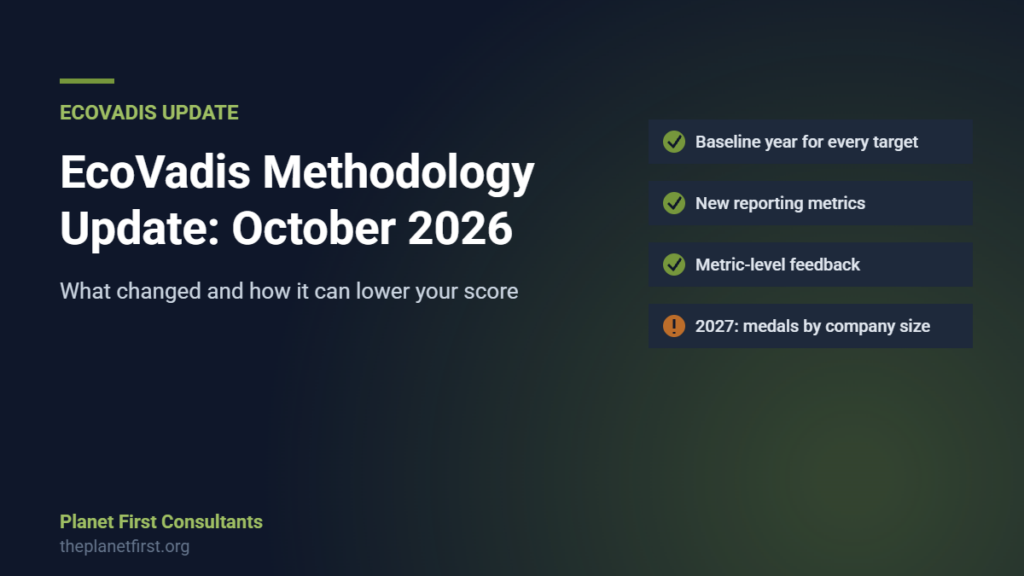
Short answer: EcoVadis updated its assessment methodology for questionnaires submitted from 14 October 2026. The change most likely to cost you points is that every quantitative target in your policies must now state a baseline year; a target without one is rejected and no longer counts towards your Policy score. The update also reorganises the Reporting questions around more than ten new standardised metrics and gives more detailed scorecard feedback. Separately, EcoVadis partners report that from January 2027 medal thresholds will vary by company size.
If your EcoVadis reassessment falls in the coming months, this guide explains each change, who it affects, and what to fix before you submit so that your score does not drop for reasons that have nothing to do with your actual performance.
The October 2026 EcoVadis update at a glance
| Change | Applies from | Who is affected | Risk to your score |
|---|
| Baseline year required for quantitative targets | 14 October 2026 | All company sizes with quantitative policy targets | High: targets without a baseline year are rejected |
| Reporting questions reorganised; more than ten new standardised metrics | 14 October 2026 | All companies answering Reporting questions | Medium: data gaps become visible |
| Metric-level feedback for Ethics and Sustainable Procurement | 14 October 2026 | Companies rated on these themes | None (feedback only) |
| “Other” answer options confirmed as optional | 14 October 2026 | All companies | None |
| VSME renamed “Voluntary Standard (VS/VSME)” | 14 October 2026 | XS, S and M companies | None |
| New Living Modified Organisms option under Biodiversity | 14 October 2026 | Medium and large companies in certain industries | None (new way to earn credit) |
| Temporary-worker metrics limited to staffing agencies | 15 October 2026 | Temporary staffing agencies | None |
The methodology version that applies to you is set by the date you submit your questionnaire, not the date your scorecard is published.
The change most likely to lower your score: baseline years for targets
From 14 October 2026, every quantitative target you declare under the Policies indicator must state three things: the target value, the target year and the baseline year. According to EcoVadis’s update notes, if no baseline year is documented, the declaration is rejected and does not contribute to the Policy indicator score. This applies to relative reduction targets, absolute targets and zero-incident commitments alike.
Two details catch companies out:
- The baseline must be in the evidence, not just the questionnaire. Writing the baseline year in your answer is not enough; the policy, target register or report you upload must show it.
- Consistency matters. If your environmental policy says 2022, your sustainability report says 2023 and your GHG inventory uses 2021, the analyst cannot credit the target with confidence. Pick one baseline per target and use it everywhere.
A target written to the new standard looks like this: “Reduce absolute Scope 1 and 2 GHG emissions by 30% by 2030 from a 2023 baseline.” Targets EcoVadis has already accepted remain valid until they expire, but anything you submit or resubmit now must follow the new rule.
This matters more than it looks, because EcoVadis expects small, medium and large companies to have quantitative targets for at least half of their key Environment and Labour & Human Rights criteria. A company that loses several targets at once can see its Policy scores fall across two themes. If you are setting a GHG baseline for the first time, our UAE GHG reporting guide explains how to choose a base year.
New standardised reporting metrics
EcoVadis has replaced 19 general “other metrics” options with topic-specific questions that appear only when the topic is material to your company, and has added more than ten new standardised metrics aligned with GRI, ESRS, the Voluntary Standard and ISSB. Examples include:
- number of sites owned, leased or managed in or near biodiversity-sensitive areas (replacing the old yes/no question);
- employee turnover rate;
- percentage of employees covered by elected representatives or collective agreements;
- number of identified child, forced or compulsory labour incidents;
- number of identified human rights incidents affecting external stakeholders.
The new metrics are assessed under the existing scoring principles for the Reporting indicator, so the calculation has not changed. What has changed is visibility: a metric you cannot report now appears as a gap on your scorecard. For UAE companies, HR and payroll systems usually hold the turnover and workforce data already; the work is in extracting it for the assessed period and documenting how it was calculated.
The other October 2026 changes
- Metric-level feedback for Ethics and Sustainable Procurement. Scorecards now show strengths and improvement areas for individual reporting metrics in these two themes. EcoVadis states that the Reporting scoring methodology is unchanged, but the feedback is a ready-made checklist for your next cycle.
- “Other” options are optional. Leaving “other” unselected under Measures, Endorsements and Certificates does not reduce your score, provided your other answers are evidenced. Only use it when you have a real, documented answer.
- VSME is now “Voluntary Standard (VS/VSME)”. A change of name only; VSME-aligned reports remain valid.
- New Biodiversity option for Living Modified Organisms. Relevant to certain agriculture, aquaculture, pharmaceutical, research and waste-treatment activities; it adds a way to earn credit.
- Temporary-worker metrics. Training hours and gender share for temporary workers now apply only to temporary staffing agencies.
Earlier 2026 changes that still cost suppliers points
The October update builds on changes made earlier in 2026, which we covered in EcoVadis Scoring 2026: What Changed for UAE Suppliers. The ones we still see causing score drops are:
- management system certificates marked “in progress” are no longer accepted (April 2026);
- policy and reporting coverage is measured by sites or headcount, not turnover, with at least 80% of operations covered and 95% for energy and GHG data (April 2026);
- Scope 2 emissions must be reported both location-based and market-based (May 2026), and Scope 2 reduction targets must state which method they use (July 2026);
- EcoVadis no longer contacts most companies during analysis about wrongly formatted documents or certificates declared without evidence (July 2026), so mistakes go straight into the score;
- you get two business days to review your scorecard for factual errors before it is published, after which it publishes automatically.
Coming in 2027: medal thresholds by company size
EcoVadis partners, including Anthesis in its October 2026 briefing, report that from 12 January 2027 medal thresholds will vary by company size, and that fewer large companies are expected to keep the highest medals. At the time of writing, EcoVadis’s public Medals Methodology (V2.0, applicable from January 2026) still applies a single set of percentiles to all companies: Platinum top 1%, Gold top 5%, Silver top 15% and Bronze top 35%, with a minimum of 30 in every theme. We will update this article when EcoVadis publishes the new thresholds.
The practical point is the same either way: do not assume that keeping the same score will keep the same medal. If a medal matters to a customer contract, plan your next submission with some margin above last year’s score.
What to do before your next EcoVadis submission
- Audit every quantitative target in your policies and reports, and add a consistent baseline year to each one.
- Map the new reporting metrics to the data you already hold in HR, HSE, procurement and finance, and fill the gaps for the assessment period.
- Check certificates: valid, issued by an accredited body, covering the assessed sites, and not “in progress”.
- Check coverage: policies and KPIs covering at least 80% of sites or employees, and 95% for energy and GHG.
- Prepare Scope 2 on both a location-based and a market-based basis.
- Check document formats and names before submitting, and keep your team available for the two-day pre-publication review.
For the full improvement plan, see how to improve your EcoVadis score.
Frequently asked questions
When does the EcoVadis October 2026 methodology update apply?
It applies to questionnaires submitted on or after 14 October 2026 (15 October for the temporary-worker metrics). The methodology version used for your assessment is set by your submission date, not your publication date.
Will my existing EcoVadis targets still count?
Targets EcoVadis has already accepted remain valid until they expire. Any quantitative target you submit or resubmit from 14 October 2026 must state a baseline year, a target year and a target value, and the baseline must appear in your supporting evidence.
Has EcoVadis changed how the score is calculated?
No. The indicator weights and the scoring principles for the Reporting indicator are unchanged. The update changes what evidence is accepted, which reporting metrics are asked, and how detailed the scorecard feedback is.
Do I have to report all the new EcoVadis metrics?
The new metrics appear only when the topic is material to your company. Metrics you cannot report earn no credit and show up as gaps on your scorecard, so it is worth collecting the data where you can.
Will EcoVadis medal thresholds change in 2027?
EcoVadis partners report that from 12 January 2027 medal thresholds will vary by company size. EcoVadis’s public Medals Methodology has not yet been updated to show the new thresholds, so check the latest version before relying on a specific cut-off.
Sources