blog

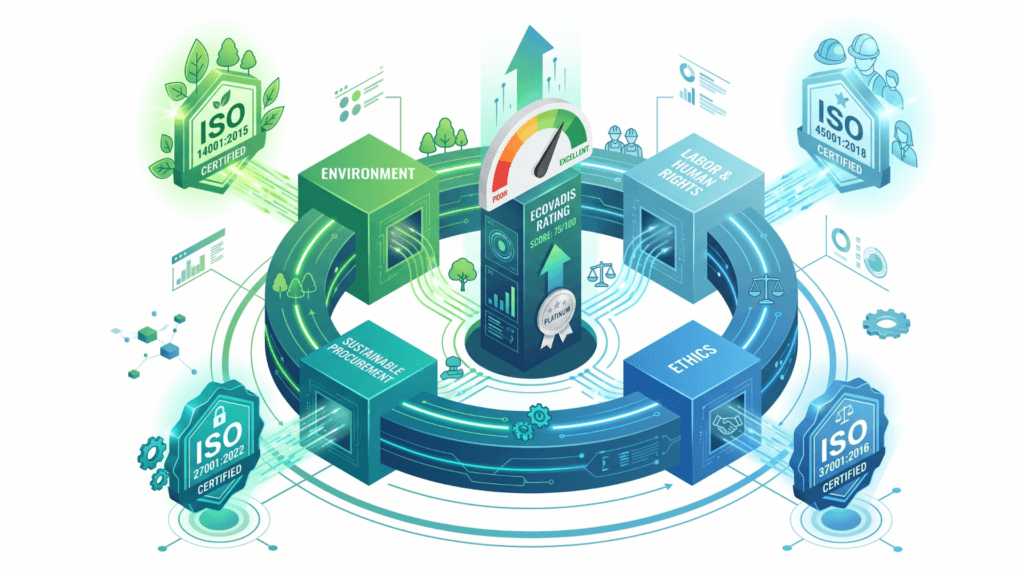
A sustainability consultant in Dubai reviewing an EcoVadis scorecard alongside ISO certification documents, illustrating the link between ISO standards and higher EcoVadis scores.
blog

How ISO Certificates Help You Achieve a Higher EcoVadis Score in UAE

Why ISO Certificates Are the Fastest Way to Improve Your EcoVadis Score By Danushka Prabhad, Senior Sustainability Consultant  |  Published May 2026 Introduction Over the past several years working with companies across the UAE, GCC, and wider MENA region on their EcoVadis assessments, I’ve seen one pattern repeat itself more times than I can count — companies stuck at the same score, year after year, wondering why nothing is moving. They answer the questionnaire carefully, they submit their documents, and yet the needle barely shifts. When I dig into their scorecards, the missing piece is almost always the same: no certifications. Let me explain why that matters — and what you can do about it right now. How EcoVadis Actually Works Before we talk about certificates, it helps to understand what EcoVadis is actually measuring. EcoVadis is built on the principles of ISO 26000 — the international standard for social responsibility. That’s not a coincidence. ISO 26000 defines the core themes of responsible business, and EcoVadis has structured its entire assessment framework around those same themes. The EcoVadis scorecard evaluates your company across four categories: Environment Labor & Human Rights Ethics Sustainable Procurement Each category is scored based on three things: the policies you have in place, the actions you’ve implemented, and the results you can demonstrate. Here’s where certifications change everything — a third-party certificate is one of the strongest forms of evidence you can provide across all three dimensions at once. The Certificate Advantage: Category by Category Environment This is where I see the biggest gap for most companies. If your business does not hold ISO 14001 (Environmental Management System), you are almost certainly leaving points on the table. ISO 14001 demonstrates that your organization has a structured, audited approach to managing environmental impacts — energy use, emissions, waste, water. EcoVadis rewards this directly. Beyond ISO 14001, depending on your industry, ISO 50001 (Energy Management) adds another layer. For companies in manufacturing or logistics here in the UAE and Gulf region, this is particularly relevant given the focus on carbon reduction and the UAE’s Net Zero 2050 commitments. Labor & Human Rights This category trips up many businesses, especially those operating across complex supply chains. ISO 45001 (Occupational Health & Safety Management) is the anchor certificate here. It shows your workforce safety isn’t just a policy on paper — it’s a managed, verified system. SA8000 is another strong credential in this space, particularly respected for social accountability. If your operations involve shift workers, migrant labor, or third-party contractors — which is common in the UAE — holding SA8000 or working toward it sends a very clear signal to EcoVadis evaluators. Ethics Ethics is one of the most underestimated categories in the EcoVadis assessment. Companies often treat it as a compliance checkbox, but EcoVadis looks for genuine anti-corruption measures, data protection practices, and responsible business conduct. Two certificates matter enormously here: ISO 37001 — Anti-Bribery Management System. This is still relatively rare in the region, which means companies that hold it stand out immediately. ISO 27001 — Information Security Management System. As data privacy regulations tighten across the Gulf (including the UAE’s PDPL), this certificate demonstrates that your organization manages information ethically and securely — something EcoVadis increasingly looks for in the Ethics category. Sustainable Procurement This is the category where supply chain transparency is everything. If your company works with timber, wood products, paper, or similar materials, FSC certification (Forest Stewardship Council) is a direct, recognized signal of responsible sourcing. For broader supply chain standards, ISO 20400 (Sustainable Procurement) and ISO 28000 (Supply Chain Security Management) are increasingly recognized as evidence of a systematic approach to responsible sourcing. If you’re in logistics, construction, or manufacturing and you’re asking how to improve EcoVadis score in procurement, these are where I’d start. “But We Already Have a Management System — Why Isn’t the Score Moving?” This is the most common question I get from clients in Dubai and across the UAE. The answer is usually one of two things: First — you have internal procedures, but they haven’t been formally certified by an accredited body. EcoVadis puts significantly more weight on externally verified evidence. An internal policy alone rarely moves the score the way a certificate does. Second — you have the certificate, but you’re not positioning it correctly in your submission. The way you present evidence in EcoVadis matters. The certificate needs to be paired with the right policies and supporting documentation in the right category. The Honest Truth About Getting Stuck If your EcoVadis score has been the same for two or three assessment cycles, it’s a signal worth taking seriously. In my experience, the companies that break through to Silver, Gold, or Platinum are almost always the ones who have committed to building a certified management system — not just filling in the questionnaire better. The good news is that many of the certifications I’ve mentioned above — ISO 14001, ISO 45001, ISO 27001, ISO 37001 — can be implemented and achieved within 6 to 12 months with the right support. For companies in the UAE and wider GCC market, this timeline often aligns well with annual EcoVadis reassessment windows. And increasingly, your buyers and partners are asking about your EcoVadis score before they make procurement decisions. A higher EcoVadis rating isn’t just a badge — it’s a competitive advantage in the market. What You Should Do Next If you’re working on your EcoVadis assessment in the UAE, Dubai, or anywhere in the region and you want to move the score meaningfully — the conversation has to start with your scorecard. Every company’s gap is different. Some need to prioritize environment. Others are struggling with ethics documentation. Some need a complete supply chain traceability process built from the ground up. What I’d encourage you to do is this: share your current EcoVadis scorecard with a consultant who can actually read it properly. Not just someone who knows sustainability in general — someone who understands how EcoVadis

A sustainability professional reviews UAE GHG emissions data ahead of the May 2026 MRV compliance deadline.
blog

UAE GHG Reporting: What Businesses Must Do Before the Deadline

UAE GHG Reporting: What Businesses Must Do Before the Deadline By Danushka Prabhad, Senior Sustainability Consultant  |  Published April 2026 Introduction If you’ve been following sustainability news in the UAE, you probably already know that climate reporting just got a lot more serious. But knowing something is coming and actually being ready for it are two very different things. Federal Decree-Law No. 11 of 2024 on the Reduction of Climate Change Effects made greenhouse gas (GHG) reporting a formal legal obligation in the UAE. Not a recommendation. Not a voluntary ESG initiative. An actual compliance requirement — with a deadline of 30 May 2026. That’s closer than most businesses realize. What Changed — and Why It Matters For years, emissions reporting in the UAE was largely driven by voluntary sustainability frameworks or pressure from international investors and supply chains. Companies that reported did so because it was good practice, not because they had to. That era is over. The new Climate Change Law establishes a national Measurement, Reporting, and Verification (MRV) system — a centralized digital platform launched by the Ministry of Climate Change and Environment (MOCCAE) in October 2025 — through which companies must measure, document, and submit their greenhouse gas emissions data. Think of it like VAT registration, but for carbon. The system is live, the rules are in place, and the clock is ticking. Who Does This Apply To? This is one of the most common questions we get at Planet First Consultancy, and the honest answer is: the law casts a wide net. It applies to entities operating in the UAE — including those in free zones — across both public and private sectors. If your company runs facilities, warehouses, plants, or offices in the UAE, or if your operations involve fuel consumption, electricity use, refrigerants, industrial processes, or logistics, you are very likely in scope. The practical rule of thumb? Don’t assume you’re exempt. Check first. Many businesses are surprised to discover they fall under the requirements — not because they’re large emitters, but because the definition of a “source” under the law is broad enough to capture most commercial operations of any meaningful size. How the Reporting Process Actually Works Let’s skip the jargon and walk through what this looks like in practice. Step 1: Figure out if you’re in scope This means reviewing your legal entity structure, your UAE sites, your business activities, and what types of emissions your operations generate. For companies with multiple entities or sites, this scope review is critical — it determines whether you’re reporting one inventory or several. Step 2: Register on the MRV platform Once you know you’re in scope, you’ll need to register on MOCCAE’s national MRV system. Have your trade license details, operational site information, and contact persons ready before you begin. Step 3: Collect your activity data This is where most companies hit their first real challenge — and where the quality of your final report is won or lost. You need documented data on electricity consumption, fuel use, refrigerant top-ups, industrial process inputs, waste, and transport. If your data is scattered across departments or sitting in paper invoices, now is the time to get organized. Step 4: Calculate your emissions Activity data gets converted into CO₂ equivalent figures using recognized emission factors and methodologies. This step requires some technical know-how — if your internal sustainability team hasn’t done this before, it’s worth getting support to make sure the numbers are consistent and defensible. Step 5: Prepare your emissions inventory and report This isn’t just filling in a form. Your report needs to show emission sources, calculation boundaries, totals, and supporting evidence. Crucially, the law also requires you to describe what you’re doing — or planning to do — to reduce your emissions. That narrative matters. Step 6: Be ready for verification The Ministry has the authority to verify your data. That means utility bills, fuel invoices, refrigerant logs, meter readings, and calculation files should all be organized and accessible. Even if external assurance isn’t mandatory in every case, being verification-ready protects you. Step 7: Submit through the MRV platform Final submission happens through the official system. After that, you’re required to retain all supporting records for a minimum of five years — and prepare to repeat the cycle. The Reporting Challenges Nobody Talks About We work with a lot of UAE businesses on their first emissions inventory, and there are patterns we see again and again. Data is siloed. Electricity bills are with the facilities team, fuel records are with operations, and refrigerant logs — if they exist at all — are somewhere else entirely. Nobody has a complete picture. There’s no internal owner. Sustainability reporting often falls into a gap between HR, finance, and operations. Without a clear point of accountability, things stall. Records are incomplete. Many companies have never tracked refrigerant use or scope 3 transport emissions at all. Starting from zero is possible, but it takes time. The emissions calculation feels abstract. Converting kilowatt-hours and liters of diesel into CO₂ equivalent figures isn’t instinctive for most teams. It requires methodology decisions and careful documentation. None of these are insurmountable. But they’re much easier to solve in early 2026 than in late April 2026. Why Starting Now Is Worth It There’s a practical argument and a strategic one. The practical argument: companies that start their data collection and scope review early have time to fix gaps, clarify ambiguities, and prepare a clean submission. Companies that wait until Q1 2026 are often scrambling — and scrambling tends to produce weak reports. The strategic argument: going through this process forces a level of emissions visibility that most businesses have never had. You learn where your carbon is actually coming from. That intelligence feeds directly into cost reduction, supply chain decisions, and ESG communications to clients and investors who are increasingly asking for this data anyway. Compliance is the floor, not the ceiling. What You Should Do Right Now If your company operates

GHG Reporting in Abu Dhabi
blog

GHG Reporting in Abu Dhabi: The Complete MRV Guide Under UAE Federal Law No. 11 of 2024

GHG Reporting in Abu Dhabi: The Complete MRV Guide Under UAE Federal Law No. 11 of 2024 By Danushka Prabhad, Senior Sustainability Consultant  |  Published March 2026 Introduction The regulatory landscape for businesses operating in the UAE has fundamentally shifted. On 30 May 2025, Federal Decree-Law No. (11) of 2024 came into force, making the UAE the first country in the MENA region to enforce climate-related corporate accountability through legislation. This is not a distant compliance exercise — it is an active legal obligation with teeth. For companies in Abu Dhabi, the stakes are particularly high. The emirate has moved ahead of the federal curve by launching its own dedicated Measurement, Reporting, and Verification (MRV) system, administered by the Environment Agency – Abu Dhabi (EAD). Understanding how these two frameworks interact — and acting on that understanding before deadlines arrive — is now a board-level priority. This guide breaks down everything your business needs to know about GHG reporting in Abu Dhabi: the legal foundations, who is covered, how the MRV system works, and what compliance looks like in practice. What Is the Abu Dhabi MRV System? The Environment Agency – Abu Dhabi (EAD) has launched an international standard carbon Measurement, Reporting, and Verification (MRV) programme as a pivotal step towards addressing carbon emissions in the emirate. The MRV system is a structured, facility-level framework that requires covered industrial operators to monitor their greenhouse gas emissions throughout the year, compile those figures into a standardised report, and submit that report for independent third-party verification. As Dr. Shaikha Al Dhaheri, Secretary-General of EAD, has stated, the programme integrates new mandatory MRV efforts into Abu Dhabi’s broader carbon accounting framework as part of national pathways towards Net Zero by 2050. The system is designed to standardise and strengthen the reporting of greenhouse gas (GHG) emissions across Abu Dhabi’s industrial and energy sectors, aligning local efforts with global best practices, to drive international competitiveness, manage long-term GHGs, and foster technical innovation at the forefront of the global climate change agenda in the region. Critically, the Abu Dhabi MRV programme is also designed as a stepping stone toward a domestic carbon pricing mechanism — meaning the data you report today will likely inform future financial obligations. UAE Federal Decree-Law No. 11 of 2024: An Overview This legislation positions the UAE as the first country in the Middle East and North Africa region to establish a binding legal framework for climate action, aligning with its Net-Zero by 2050 Strategic Initiative and its commitments under the Paris Agreement. The law’s core obligations are clear and non-negotiable: all public and private sector entities must measure, report, and actively manage their greenhouse gas emissions. The Climate Change Law was issued on 28 August 2024, came into force on 30 May 2025, and requires full compliance with its provisions by 30 May 2026. The law establishes a system of financial and administrative penalties for non-compliance. Entities failing to meet the reporting requirements or implement mandated strategies may face fines ranging from AED 50,000 to AED 2,000,000. Repeat violations within a two-year period may result in the doubling of penalties. In parallel, the government issued UAE Cabinet Decision No. 67 of 2024 concerning the National Carbon Credit Registry, further clarifying programme thresholds, verification procedures, and the scope of carbon credit eligibility. Who Needs to Report? One of the most important — and sometimes misunderstood — aspects of the law is its breadth. Federal Decree-Law No. (11) of 2024 covers all GHG-emitting entities across the public and private sectors, including those operating within free zones, and establishes mandatory obligations for emissions measurement, reporting, reduction, and participation in national climate mechanisms. At the federal level, this means every business in the UAE has an obligation. At the Abu Dhabi level, the EAD MRV system operates at the facility level within covered sectors. According to the EAD Technical Guidance published via the facilitymrv.ead.ae platform, reporting is obligatory at the Facility level operating in a Covered Sector. The obligation to monitor and report greenhouse gas (GHG) emissions falls on the Operator of the Reporting Facility. Covered sectors under the Abu Dhabi MRV programme include power generation, oil and gas, industry, and transport. In its first year, the programme collected emissions data representing approximately 90 million tonnes of Abu Dhabi’s CO₂ emissions — the bulk of emissions from major regulated activities across the emirate. For entities with very high emissions, additional obligations apply at the federal level: large emitters (≥ 0.5 million metric tons CO₂e per year) face accelerated obligations and must register with the new National Register for Carbon Credits (NRCC). Emission Thresholds and Applicability Under the Abu Dhabi MRV framework, applicability is determined by a combination of sector classification and facility-level emissions thresholds. Operators whose facilities fall within the covered sectors and breach the relevant thresholds are legally obligated to register, monitor, report, and arrange third-party verification. The EAD Technical Guidance (available via facilitymrv.ead.ae) specifies these thresholds in detail, and the EAD worked closely with public and private stakeholders to calibrate sector-specific requirements before the programme launched. At the federal level, entities emitting 0.5 million metric tonnes of CO₂ equivalent or more per year are subject to the most immediate obligations under the National Register for Carbon Credits framework. Businesses uncertain about whether they cross applicable thresholds should conduct a preliminary GHG inventory as a first step — regardless of where they believe they sit relative to thresholds. Step-by-Step MRV Reporting Process Understanding the process end-to-end is essential for planning your compliance timeline. Here is how Abu Dhabi’s facility-level MRV reporting works in practice: Step 1 – Register Your Facility Operators within covered sectors must register on the EAD’s MRV platform at facilitymrv.ead.ae. Registration captures facility details, sector classification, and key contact information. This is the gateway to all subsequent reporting obligations. Step 2 – Develop a Monitoring Plan Before reporting can begin, facilities must establish a documented monitoring plan. This plan identifies all emission sources, the monitoring methodologies to be used

Sustainable construction site featuring FSC certified timber structure with engineers reviewing EPD and LCA data for LEED and BREEAM certification
blog

How EPDs, LCA, and FSC Certified Wood Help Achieve LEED and BREEAM Credits

How EPDs, LCA, and FSC Certified Wood Help Achieve LEED and BREEAM Credits By Danushka Prabhad, Senior Sustainability Consultant  |  Published February 2025  Introduction Green building certification has moved well beyond ticking boxes. In markets as diverse as the UAE, the United Kingdom, and the United States, developers, architects, and procurement teams are under mounting pressure to demonstrate the environmental credentials of every material that goes into a building — not just in principle, but with documented, third-party-verified evidence. This is where Environmental Product Declarations (EPDs), Life Cycle Assessment (LCA), and FSC-certified wood become indispensable tools. Together, they form a powerful triad that supports compliance with LEED v4.1 and BREEAM 2018 — two of the most widely adopted green building rating systems globally — while also strengthening a project’s sustainability strategy from the ground up. Whether you are working on a commercial tower in Dubai, a mixed-use development in London, or a multifamily residential project in Chicago, understanding how these tools interact can mean the difference between a theoretical commitment to sustainability and a certifiable one. What Are EPDs and How Do They Relate to Life Cycle Assessment? An Environmental Product Declaration (EPD) is a standardised, third-party verified document that transparently communicates the environmental impact of a product across its entire life cycle. Think of it as a nutrition label for building materials — except instead of calories and carbohydrates, it reports greenhouse gas emissions, water use, ozone depletion potential, and a range of other impact categories. EPDs are governed by ISO 14025 and, for construction products, EN 15804 in Europe. In the US, the NSF/ANSI 457 standard provides additional guidance. Crucially, an EPD cannot exist without an underlying Life Cycle Assessment (LCA). The LCA Foundation A Life Cycle Assessment is a systematic methodology for quantifying the environmental inputs and outputs of a product or system from cradle to grave — or, in some frameworks, cradle to gate, gate to gate, or cradle to cradle. An LCA examines: Raw material extraction and processing (Modules A1–A3) Transportation to site (Module A4) Construction and installation (Module A5) Use phase, maintenance, and repair (Modules B1–B7) End-of-life processes including demolition and disposal (Modules C1–C4) Potential benefits from reuse and recycling (Module D) An EPD essentially packages the results of this LCA into a standardised, publicly available format that can be compared across products and incorporated into project-level sustainability documentation. Industry-Specific EPDs in Practice In the UAE, the Green Building Council has increasingly encouraged manufacturers supplying materials to Estidama Pearl-rated and LEED-certified projects in Abu Dhabi and Dubai to provide EPDs. Major cement and aluminium producers operating in the GCC have begun publishing product-specific EPDs to remain competitive in specification. In the UK, BREEAM’s Mat 01 credit (Life Cycle Impacts) explicitly requires LCA data, making EPDs the most efficient pathway for demonstrating material environmental performance. The Green Guide to Specification, while historically used, is being supplemented by EPD-backed LCA data under BREEAM 2018. In the US, the LEED v4.1 Materials & Resources category has made EPDs a central pillar of the Building Product Disclosure and Optimization (BPDO) credits, with thousands of EPDs now available through databases such as the EC3 (Embodied Carbon in Construction Calculator) tool managed by Building Transparency. How EPDs Contribute to LEED Credits Under LEED v4.1 — the current standard applicable to most new projects pursuing certification in 2025 and beyond — EPDs are directly tied to the Materials & Resources (MR) category, specifically through the Building Product Disclosure and Optimization: Environmental Product Declarations credit. BPDO: EPD Credit Structure This credit is split into two parts: Disclosure and Optimization. Disclosure (1 point): Projects must use at least 20 permanently installed building products from at least five different manufacturers that have publicly available EPDs. These can be industry-wide (generic) EPDs or product-specific EPDs. Optimization (1 point): Products must go further — demonstrating that the materials selected have environmental impacts below the industry average as declared in their EPDs, or that manufacturers have disclosed LCA data and committed to reduction programmes. In practical terms, this means that for a 10-storey commercial building in Houston or a mixed-use development in Manchester, the project team needs to systematically collect EPDs for structural materials, cladding systems, insulation, finishes, and MEP products. This is not a passive exercise — it requires proactive supply chain engagement. EPDs and Embodied Carbon Reduction One increasingly important dimension of LEED v4.1 in 2025 is the focus on whole-life carbon, including embodied carbon — the carbon emissions locked into materials during manufacturing. EPD data feeds directly into whole-building LCA tools such as One Click LCA and Tally, enabling project teams to compare material options and select lower-carbon alternatives. In the UAE, where rapid construction activity in cities like Riyadh, Abu Dhabi, and Dubai has placed sustainability under the spotlight ahead of national net-zero targets, EPD-driven material selection is becoming a differentiator in developer-led ESG reporting as well as in formal certification. FSC-Certified Wood and Its Role in LEED and BREEAM Credits Timber and wood-based products occupy a unique position in sustainable construction. When responsibly sourced, wood is a renewable, low-carbon material with outstanding structural and aesthetic potential. When sourced irresponsibly, it contributes to deforestation, biodiversity loss, and carbon release on a significant scale. The Forest Stewardship Council (FSC) is the globally recognised body that certifies forests managed according to rigorous environmental, social, and economic standards. FSC-certified wood provides an auditable chain of custody from forest to building site. FSC Wood and LEED v4.1 Under LEED v4.1, FSC-certified wood contributes primarily to two credit areas: Building Product Disclosure and Optimization — Sourcing of Raw Materials (1 point): FSC-certified wood products count toward the 25% by cost threshold for raw materials that are responsibly sourced. Each FSC-certified product counts as contributing 100% of its value to this calculation, compared to other sourcing criteria where only 50% of the value may count. Wood and Agrifiber Products pilot credit: For projects in the US that incorporate mass timber — cross-laminated timber (CLT), glulam, or nail-laminated timber

How to Register Your Company on EcoVadis Step-by-Step Global Guide
blog

How to Register Your Company on EcoVadis (Step-by-Step Guide)

How to Register Your Company on EcoVadis (Step-by-Step Guide) Learn how to register your company on EcoVadis with this step-by-step guide. A complete walkthrough for suppliers and businesses in the UAE, Saudi Arabia, UK, US, Canada, Australia, Germany, France, Italy, Netherlands, New Zealand and globally. Introduction: Why This Guide Matters EcoVadis is one of the world’s most recognized sustainability rating platforms, used by global buyers and multinational corporations to assess supplier ESG performance. Companies across the UAE, Saudi Arabia, United Kingdom, United States, Canada, Australia, New Zealand, Germany, France, Italy, and the Netherlands are increasingly required to complete EcoVadis assessments as part of supply chain due diligence. If your customer has requested an EcoVadis assessment — or if you want to strengthen your sustainability credentials — the first step is registration. In this guide, we walk you through the exact EcoVadis company registration process, based on the actual platform screens, so you can complete the setup confidently and correctly. Step 1: Access the EcoVadis Registration Page Begin by visiting the official EcoVadis registration link. On the registration page, you will see a simple contact form requesting: First Name Last Name Business Email Address Phone Number Company Name After completing the required fields, click “Register.” Best Practice: Always use a company domain email (e.g., name@company.com). Personal email addresses may delay verification. Step 2: Email Confirmation After clicking “Register,” a confirmation message appears instructing you to check your email. EcoVadis sends a verification email to the business email address you provided. Open the email and click the activation link to proceed. Step 3: Create Your EcoVadis Password Once you click the email link, you will be redirected to a secure page where you must: Create a password Confirm the password After setting your password, your account is activated. You can now log in to the EcoVadis platform using your email and newly created password. Step 4: Welcome to the EcoVadis Platform After logging in, you will see a welcome screen displaying your name. Click “Let’s Get Started” to begin completing your company profile. This is where the formal registration process begins. Step 5: Access the Dashboard – Complete Company Profile You will now see the EcoVadis dashboard. Locate and click: “Complete Company Profile” This section is mandatory before the questionnaire is generated. Step 6: Enter Company Name and Website The first section of the profile requires: Legal Company Name Company Website URL Ensure the information matches your official registration documents and website records. Accuracy here is important because this data is linked to your final EcoVadis assessment. Click Next to proceed. Step 7: Define the Scope of the Assessment The first section of the profile requires: Legal Company Name Company Website URL Ensure the information matches your official registration documents and website records. Accuracy here is important because this data is linked to your final EcoVadis assessment. Click Next to proceed. Step 8: Specify Business Location You will be asked to confirm the location of your company. Select the country where the assessed entity is located. EcoVadis tailors questionnaires partially based on geography and regulatory context, so ensure this is accurate. Click Next. Step 9: Number of Employees Next, select the number of employees working at the assessed company or site. EcoVadis uses company size as a parameter to: Adjust questionnaire complexity Determine documentation expectations Select the correct employee range and click Next. Step 10: Select Your Industry (Critical Step) This is one of the most important steps in the registration process. You must select the industry that best matches your company’s business activities. Many companies struggle at this stage because: Industry categories may not exactly match internal terminology Companies operate in multiple sectors The description may feel broad Choosing the wrong industry can result in an irrelevant or overly complex questionnaire. If you are unsure which industry best fits your company’s scope of activities, it is advisable to seek expert guidance. At Planet First Consultants, we support companies globally — including in the UAE, Saudi Arabia, UK, US, Canada, Australia, Germany, France, Italy, the Netherlands, and New Zealand — in selecting the most accurate EcoVadis classification.Contact Us today. We are happy to guide you on this step without charge. After selecting your industry, click Next. Step 11: Review and Confirm Company Profile Summary You will now see a Company Profile Summary page. This page displays all previously entered information, including: Company name Website Scope Location Number of employees Industry Carefully review all details. If everything is correct, click Confirm. Step 12: Registration Completed Once confirmed, you will see a message stating: Your company profile has been successfully submitted Your EcoVadis questionnaire is being prepared EcoVadis typically takes 2–3 business days to generate your tailored sustainability questionnaire. There is nothing further to complete at this stage. You will be notified once your questionnaire is available. What Happens Next? After registration: EcoVadis builds your customized ESG questionnaire You will receive access to upload supporting documentation The assessment process officially begins Proper preparation before starting the questionnaire significantly improves your scoring potential. Final Thoughts While the EcoVadis registration process appears simple, many companies face challenges when: Selecting the correct industry classification Defining the appropriate assessment scope (Group vs Entity vs Site) Preparing documentation aligned with EcoVadis themes Understanding questionnaire expectations Structuring policies and evidence properly A small mistake at the registration stage can lead to an irrelevant questionnaire or unnecessary complexity later in the assessment. At Planet First Consultants, we support companies globally — including businesses in the UAE, Saudi Arabia, UK, United States, Canada, Australia, New Zealand, Germany, France, Italy, and the Netherlands — with: EcoVadis registration guidance Industry classification support Questionnaire preparation ESG documentation structuring Score improvement strategy If you are unsure about any step, we are happy to guide you. Book a Free Consultation Call We offer an initial free consultation to: Clarify your EcoVadis scope Identify potential risks before submission Provide practical next steps Our goal is simple: help you complete the EcoVadis process confidently and strategically. Explore More…… Our EcoVadis Consultancy

ISO 14019, the new international standard for verifying sustainability and ESG information
blog

ISO 14019: What You Need to Know About the New Sustainability Verification Standard

ISO 14019: What You Need to Know About the New Sustainability Verification Standard If you’ve been following sustainability reporting lately, you’ve probably noticed something: everyone’s talking about credibility. Investors want proof. Regulators are tightening rules. And customers are getting better at spotting greenwashing. That’s where ISO 14019 comes in. This new international standard is reshaping how companies verify their sustainability claims—and it’s particularly relevant if you’re operating in markets like the UAE where ESG disclosure expectations are rising fast. What Exactly Is ISO 14019? ISO 14019 is an environmental management standard that sets out how sustainability information should be independently checked and verified. Think of it as the rulebook for proving your ESG data is accurate. The standard is built in four parts: ISO 14019-1 establishes the core principles and requirements that apply to all validation and verification work. ISO 14019-2 covers the detailed verification process for historical data—things like last year’s emissions or current diversity metrics. ISO 14019-3 (still in development) will focus on validating forward-looking statements, such as climate targets or transition plans. ISO 14019-4 sets requirements for the organizations and professionals who actually perform this verification work. The key difference from other standards? ISO 14019 doesn’t tell you what to report. It tells you how to prove what you’re reporting is real. Why Was This Standard Necessary? The short answer: because trust was breaking down. As sustainability reporting exploded over the past decade, so did the number of questionable claims. Carbon neutral products that weren’t. Net-zero commitments with no credible pathway. Social impact figures that couldn’t be backed up. Regulators, investors, and the public started demanding better. The EU introduced mandatory assurance requirements under its Corporate Sustainability Reporting Directive. Investors began asking harder questions about ESG data quality. Greenwashing lawsuits multiplied. ISO 14019 emerged from this pressure. Developed through ISO’s technical committee on environmental management (ISO/TC 207), the standard provides a unified approach to verification that works across different reporting frameworks and jurisdictions. It’s designed to give everyone—from CFOs to compliance officers to external auditors—a consistent way to talk about what “verified” actually means. How ISO 14019 Fits Into the Sustainability Landscape If you’re already familiar with standards like ISO 14001 or ISO 14064, here’s how ISO 14019 relates: ISO 14001 helps you build an environmental management system. ISO 14019 helps verify what that system produces when you report on it. ISO 14064 gives you methodologies for calculating greenhouse gas emissions. ISO 14019 can be used to verify those emissions alongside your broader ESG disclosures. GRI, ISSB, CSRD—these frameworks define what sustainability information to disclose. ISO 14019 defines how to get that information assured. What makes ISO 14019 particularly useful is its scope. Unlike narrower verification standards focused on carbon or energy, this one covers the full ESG range: environmental metrics, social performance, governance data, and both numbers and narrative content. That breadth matters because modern sustainability reporting isn’t just about emissions anymore. It’s workforce data, supply chain transparency, board composition, water use, human rights due diligence—the list goes on. You need an assurance framework that can handle all of it. Why UAE Companies Should Pay Attention ISO 14019 is an international standard, which means it’s relevant everywhere—including the Middle East. For companies in the UAE, several factors make this standard worth understanding now: Capital markets access. If you’re raising funds internationally or working with global investors, credible ESG data is increasingly non-negotiable. Verified information under a recognized standard like ISO 14019 strengthens your position. Regional momentum. Stock exchanges across the Gulf are rolling out ESG disclosure guidance. National sustainability agendas are accelerating. The regulatory direction is clear, even if timelines vary. Green finance. Whether you’re issuing green bonds, securing sustainability-linked loans, or participating in climate funds, lenders want evidence. Validated sustainability claims reduce risk and can improve terms. Reputation protection. As greenwashing scrutiny intensifies globally, unverified claims carry reputational and potentially legal risk. Verification provides a documented defense. At Planet First Consultants, we’re already working with UAE-based organizations to prepare their sustainability data for external assurance. The companies getting ahead of this are the ones building verification-ready systems now—before it becomes a rushed compliance exercise. Practical Steps for Getting Started You don’t need to implement ISO 14019 overnight, but you can start preparing: Audit your current sustainability data collection. Can you trace reported figures back to source documents? Are controls in place? Is the process documented? Identify what needs verification. Not all sustainability information requires the same level of assurance. Focus on material metrics and regulatory requirements first. Understand your assurance options. Limited assurance, reasonable assurance, mixed engagements—each has different implications for cost, scope, and credibility. Talk to your assurance provider early. Whether that’s your financial auditor, a specialist ESG verifier, or a consultancy, get them involved during reporting design, not after. What This Standard Really Signals ISO 14019 represents more than just another compliance checkbox. It marks a fundamental shift in how sustainability information is treated. For years, ESG reporting lived in a different world from financial reporting—softer expectations, less scrutiny, more room for storytelling. That gap is closing. As sustainability data becomes decision-critical for investors, lenders, and regulators, it’s being held to the same standards of accuracy and reliability as financial statements. The organizations that recognize this early—and build verification into their DNA rather than bolting it on at the last minute—will be the ones that maintain stakeholder trust when scrutiny intensifies. Because it will intensify. The question isn’t whether your sustainability claims will be challenged. It’s whether you’ll be ready with credible answers. Explore More…… Our Sustainability Reporting services in UAE Our ISO Certificate Consultancy services Our GHG Reporting service in UAE All Posts blog Cases ISO 14019: What You Need to Know About the New Sustainability Verification Standard ISO 14019: What You Need to Know About the New Sustainability Verification Standard If you’ve… Read More How to Read an EPD Report How to Read an EPD: A Practical Guide for Construction Professionals Why EPDs Are Often… Read More Everything You Need

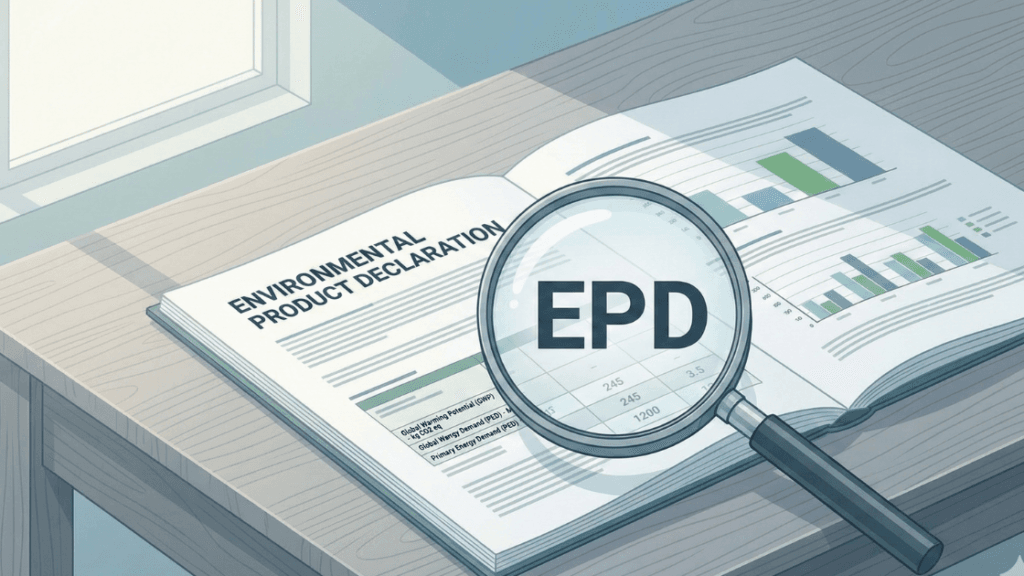
Illustration showing how to read an Environmental Product Declaration (EPD) report using a magnifying glass to examine EPD data tables.
blog

How to Read an EPD Report

How to Read an EPD: A Practical Guide for Construction Professionals Why EPDs Are Often Difficult to Understand If you’ve ever opened an Environmental Product Declaration and felt overwhelmed, you’re not alone. EPDs are standardized technical documents that communicate complex environmental information in a consistent format. While this standardization ensures comparability, it can make EPDs appear intimidating to those unfamiliar with life cycle assessment methodology. EPDs follow a predictable structure. Once you understand the key concepts and terminology, they become accessible. This guide will walk you through the essential elements you need to interpret EPD data confidently. What an EPD Actually Tells You An Environmental Product Declaration is an independently verified document that reports the environmental impacts of a product across its life cycle. Think of it as a nutrition label for building materials—it presents standardized environmental data based on life cycle assessment. What EPDs can do: Provide transparent, comparable environmental data when products share the same category rules Support green building certifications and sustainable procurement decisions Help identify environmental hotspots in a product’s life cycle Enable informed comparisons between similar products What EPDs cannot do: Tell you if a product is “good” or “bad” for the environment Serve as the sole basis for product selection Compare products across different categories without expert interpretation Replace other product quality or performance criteria Critically, EPDs report environmental data, not product quality, safety, or fitness for purpose. A product with lower carbon emissions may not necessarily be the right choice for your project if it doesn’t meet performance requirements. Key Terms You Must Understand Before Reading an EPD Declared Unit vs Functional Unit These two terms are fundamental to interpreting EPD results correctly. The declared unit is the quantity of product for which environmental data is reported. This might be “1 kg of material,” “1 m² of board,” or “1 tonne of concrete.” The declared unit is always clearly stated at the beginning of an EPD. The functional unit describes the product’s function over a reference period. For example: “1 m² of flooring, with a 25-year service life, capable of withstanding Class 33 commercial traffic.” Why this matters: When comparing two flooring products, one might report impacts per square meter while another reports per kilogram. If Product A weighs twice as much as Product B per square meter, you need to adjust for this difference. Additionally, if one product lasts 25 years and another lasts 50 years, the long-term environmental performance differs significantly. Always check the declared unit before interpreting or comparing EPD data. System Boundary The system boundary defines which life cycle stages are included in the assessment. Not all EPDs cover the same scope. A complete system boundary might include raw material extraction, manufacturing, transportation, installation, use phase (maintenance, replacement, energy consumption), and end-of-life (demolition, waste processing, disposal). However, some EPDs cover only production (“cradle-to-gate”), while others include the full life cycle (“cradle-to-grave”). Why this matters: When comparing products, ensure they have comparable system boundaries. A cradle-to-gate EPD cannot be directly compared with a cradle-to-grave EPD without careful analysis. Life Cycle Modules (A1–D) EPDs organize environmental data into standardized life cycle modules, typically following the EN 15804 structure: A1–A3: Product Stage A1: Raw material extraction and processing A2: Transport to manufacturing facility A3: Manufacturing This is the core production phase and is included in virtually all EPDs. A4–A5: Construction Stage A4: Transport to construction site A5: Installation and construction waste These modules depend on project-specific information and may show as “not declared” if generic scenarios aren’t provided. B1–B7: Use Stage B1: Use B2: Maintenance B3: Repair B4: Replacement B5: Refurbishment B6: Operational energy use B7: Operational water use Many products have minimal use-stage impacts, while others have significant impacts like windows affecting building energy performance. C1–C4: End-of-Life Stage C1: Deconstruction/demolition C2: Transport to waste processing C3: Waste processing C4: Disposal Module D: Benefits Beyond the System Boundary This optional module shows potential environmental benefits from material recovery or recycling at end-of-life. Module D values are reported separately and can be negative, indicating environmental credits. What zero or blank values mean: If a module shows zero or “not declared,” it doesn’t mean there’s no impact—it means the impact wasn’t calculated or isn’t relevant. For example, concrete EPDs might show zeros for modules B2–B5 because concrete typically requires no maintenance during the building’s life. Why Module D can be negative: When materials are recycled and offset virgin material production elsewhere, this creates an environmental benefit reported as a negative value. This doesn’t reduce the product’s actual impacts but shows potential benefits if end-of-life assumptions are realized. Understanding Common LCA Impact Categories in an EPD EPDs report multiple environmental indicators: Global Warming Potential (GWP) measures greenhouse gas emissions in kg CO₂ equivalent. This is typically the most referenced indicator, but shouldn’t be the only factor in decision-making. Ozone Depletion Potential (ODP) measures substances that deplete the stratospheric ozone layer in kg CFC-11 equivalent. Values are often very low for modern products. Acidification Potential (AP) measures emissions contributing to acid rain in kg SO₂ equivalent, primarily from combustion processes. Eutrophication Potential (EP) measures nutrient enrichment in water bodies in kg PO₄ equivalent, often relating to agricultural inputs and certain manufacturing processes. Primary Energy Use is reported separately for renewable and non-renewable sources in megajoules (MJ), showing total energy demand across the product’s life cycle. Why one indicator isn’t enough: A product with low carbon emissions might have high water consumption or resource depletion. Sustainable decision-making requires considering multiple indicators alongside performance, cost, and project requirements. System diagram showing the life cycle stages of an aluminum frame Environmental Product Declaration (EPD) from A1 to D. Understanding Common LCA Impact Categories in an EPD EPDs report multiple environmental indicators: Global Warming Potential (GWP) measures greenhouse gas emissions in kg CO₂ equivalent. This is typically the most referenced indicator, but shouldn’t be the only factor in decision-making. Ozone Depletion Potential (ODP) measures substances that deplete the stratospheric ozone layer in kg CFC-11 equivalent. Values are often very

EPD logo Showing in front of Dubai Landscape
blog

Everything You Need to Know About EPDs: All Questions Answered

Everything You Need to Know About EPDs: All Questions Answered Home Everything You Need to Know About EPDs: All Questions Answered What is an Environmental Product Declaration? An EPD is a standardised, third-party verified report that discloses the environmental impacts of a product across its life cycle — from raw material extraction through to end of life. It follows rules set by Product Category Rules (PCRs) and is aligned with international standards such as ISO 14025 and EN 15804. An EPD does not say a product is “green.” It quantifies and declares the footprint — global warming potential, water use, waste generation — so that buyers can make informed decisions. It is a disclosure tool, not a performance label. How is an EPD different from an LCA report or a sustainability certificate? These three terms are often used interchangeably, but they are not the same thing. LCA report — A Life Cycle Assessment study. It can be confidential, internal, and does not need to follow a public PCR or be verified by a third party. It is the technical foundation that an EPD is built on. EPD — A public, PCR-based, third-party verified declaration of LCA results. It follows a fixed format so that products can be compared. Sustainability certificate or eco-label — Typically sets a performance threshold. A product either meets it or does not. An EPD sets no such threshold — it simply reports the numbers. Why are EPDs important for construction and manufacturing in the UAE? Construction materials — particularly concrete and steel — are among the largest sources of embodied carbon in any building. As green building frameworks in the UAE (Estidama, Dubai Green Building Regulations) increasingly favour products backed by credible environmental data, EPDs become the primary evidence base for specification, procurement, and compliance. For manufacturers, EPDs open doors to projects where sustainability data is expected. For developers and contractors, they provide the quantified input needed to meet green building credits and satisfy client requirements. Is EPD mandatory in the UAE? Not currently across the board. UAE frameworks such as Estidama and Dubai Green Building Regulations increasingly favour or implicitly encourage products with EPDs, but outright mandates remain limited at the federal and emirate level. However, the direction of travel is clear. Policy discussions at the national level recommend introducing embodied-carbon requirements and explicitly promoting EPD use for construction products as part of net-zero alignment. Companies that build EPD capability now are better positioned when requirements tighten. Get Free EPD Consultation With Our Experts Contact Us Are EPDs mandatory anywhere in the GCC? No GCC country has introduced a blanket EPD mandate comparable to what is emerging in Europe. Uptake across the region is driven primarily by green building standards and international client expectations. Saudi Arabia and the UAE lead in EPD availability, but adoption remains at a medium-to-low level compared with European or Australian markets. How much does EPD certification cost in Dubai or the UAE? The cost of developing an Environmental Product Declaration (EPD) is not fixed and can vary significantly depending on several factors, including the selected program operator, verifier fees, the number of EPDs to be published, and the complexity of the product and supply chain. As a result, EPD costs can range widely. In most cases, total costs typically fall between AED 15,000 and AED 45,000, depending on project scope and verification requirements. Additional costs may arise when technical documentation is incomplete, when multiple product variants are included under one declaration, or when several rounds of verifier review are required. Careful preparation of internal data and clear product structuring at an early stage remains the most effective way to control overall costs and timelines. At Planet First Consultants, we intentionally provide more affordable and transparent pricing than the market average in the UAE. Our mission is to make sustainability and EPDs accessible to organisations of all sizes, including small and medium-sized enterprises. This is achievable due to our strong industry presence, long-term working relationships with accredited program operators and verifiers, and the efficiency of our expert consulting team, allowing us to deliver high-quality EPDs at competitive costs. What drives the cost of an EPD up or down? The main cost drivers are: Product complexity — A single-material product is cheaper to model than a multi-component system or a composite façade. Number of variants — One EPD covering a product family costs less per product than individual declarations. Data quality — Poor or incomplete internal data forces more verifier rounds and additional modelling effort. Verification rounds — Each round of feedback adds time and cost. Well-prepared documentation reduces this significantly. Programme operator fees — Registration and verification fees vary by operator and region. How long does it take to get an EPD? A straightforward EPD — single product, good data, experienced team — typically moves from kick-off to publication in two to six months. Complex products, multi-site averages, or slow primary-data collection commonly push timelines beyond six months. Verifier availability is an increasingly common bottleneck. Popular programme operators can have queues that delay publication even when the LCA work is complete. What data do I need to produce an EPD? The core requirement is plant-level, primary data covering: Energy consumption and fuel types Raw materials (quantities and origins) Water use Waste streams (type and disposal route) Transport distances (inbound and outbound) Packaging materials Secondary data from generic databases can fill gaps where primary data is unavailable, but over-reliance on it weakens the EPD during verification. Under EN 15804+A2, additional detail on end-of-life scenarios and recycling assumptions is also required. What is EN 15804+A2 and does it apply in the UAE? EN 15804+A2 is the current European standard for construction-product EPDs. It is mandatory for new EPDs in Europe and expands the scope beyond earlier versions by requiring more impact categories, more detailed end-of-life modelling, and Module D (benefits beyond system boundary) reporting. It does not formally apply in the UAE, but it is the most widely recognised framework internationally. Any

blog

EPD Program Operators Guide 2026

EPD Program Operators: How to Choose, Credibility, and Global Overview If you’re a UAE business seeking to demonstrate environmental transparency, you’ve likely encountered Environmental Product Declarations (EPDs). These standardized documents communicate product environmental impact based on Life Cycle Assessment (LCA) data, and they’re increasingly demanded by green building projects and sustainability-conscious customers across Dubai and the Gulf region. But here’s what many companies discover too late: not all EPDs carry equal weight. The credibility of your Environmental Product Declaration depends heavily on which EPD program operator you choose. Select the wrong operator, and your EPD might not be recognized in key markets. Choose wisely, and your verified EPD becomes a powerful competitive tool. For businesses navigating sustainability reporting UAE requirements in 2025-2026, understanding EPD program operators isn’t optional—it’s essential. What Is an EPD Program Operator? An EPD program operator manages the development, verification, and registration of Environmental Product Declarations. They ensure EPDs meet ISO 14025 standards and maintain registries of published declarations. Program operators establish Product Category Rules (PCRs)—specific methodologies for conducting LCA consultancy for particular product categories. They coordinate independent third-party verification, publish verified EPDs in accessible databases, and ensure ongoing compliance with international standards. For UAE companies, your chosen program operator affects whether your EPD will be recognized by LEED, BREEAM, Estidama, or other green building programs—directly impacting market access. Global Overview of Major EPD Program Operators International EPD System (Sweden) The world’s largest program operator, with over 2,500 published EPDs representing approximately 40% of all global declarations. It covers virtually all product categories and is recognized across Europe, North America, the Middle East, and Asia. For Dubai-based manufacturers serving international markets, this operator typically offers the broadest acceptance. IBU – Institut Bauen und Umwelt (Germany) IBU operates the German EPD program, focused primarily on construction products. With approximately 1,000 published EPDs (roughly 15% globally), IBU holds particular strength in European construction markets. UAE construction product manufacturers targeting Europe often find IBU registration strategically valuable. UL Environment (USA) Serving primarily North American markets with around 500 published declarations (approximately 8% globally). For UAE businesses with North American customers—common in aluminum, aggregates, or specialized construction materials—UL Environment ensures market access. EPD Australasia Serving Australia, New Zealand, and the Asia-Pacific region with approximately 300 registered EPDs (about 5% globally). Given GCC trade connections to Asian markets, this operator offers relevance for regional supply chains. Other Notable Operators The remaining roughly 30% of global EPDs are distributed across regional or sector-specific programs including RTS (Sweden), ECO EPD (Turkey), AENOR (Spain), BRE (UK), and ASTM International (USA). Assessing Program Operator Credibility ISO 14025 Compliance Legitimate program operators must comply with ISO 14025, the international standard for Type III environmental declarations. Always verify explicit ISO 14025 compliance—this isn’t negotiable for credible EPD registration. ECO Platform Membership ECO Platform is a European initiative that mutually recognizes EPD programs meeting stringent quality criteria. Members undergo regular audits ensuring high standards for PCR development, verification processes, and data quality. Major ECO Platform members include the International EPD System, IBU, INIES (France), EPD Norge (Norway), and RTS. ECO Platform membership signals that EPDs will be recognized across European green building schemes—critical for UAE exporters serving European markets. Verification Process Rigor Credible operators require independent third-party verification by qualified verifiers. Check whether the program operator: Maintains a network of approved verifiers with relevant expertise Requires verifier independence from LCA practitioners Provides clear verification protocols and reviewer qualifications Publishes verification statements with each EPD International Recognition The best program operator depends on your target markets. Research whether EPDs are accepted by: Green building certifications in key markets (LEED, BREEAM, Estidama, GSAS) Major customers or procurement frameworks you serve Industry-specific sustainability programs For UAE businesses serving diverse international markets, operators with broad recognition like the International EPD System typically offer the safest choice. Transparency and Accessibility Reputable operators maintain publicly accessible databases. Verify that the operator: Publishes EPDs in searchable online databases Provides EPDs in multiple languages where relevant Makes PCRs freely available Maintains clear program documentation Choosing the Right Operator for Your UAE Business Geographic Market Alignment If you primarily serve GCC and Middle East markets, ensure chosen operators’ EPDs are recognized by regional green building programs. Estidama, LEED (extensively used across UAE and Saudi Arabia), and QSAS all accept EPDs from major international operators. For businesses with European export markets—common in UAE aluminum, stone, and specialty construction—prioritize operators with ECO Platform membership. Product Category Expertise Check whether your product category has established PCRs with target operators. Developing new PCRs adds time and cost. Major operators like the International EPD System have PCRs for hundreds of categories, while specialized operators may offer deeper sector expertise. Cost and Timeline EPD registration costs typically range from €2,000-€5,000 (excluding LCA consultancy Dubai and verification costs). Timelines from LCA completion to verified EPD publication usually span 3-6 months. For time-sensitive projects, confirm typical processing times before committing. Long-Term Strategic Value EPDs typically remain valid for five years with renewal options. Choose operators with demonstrated stability and growing market recognition rather than selecting purely on lowest cost. Practical Steps for Dubai and UAE Businesses Conduct LCA: Complete Life Cycle Assessment following ISO 14040/14044 standards through internal expertise or experienced LCA consultancy UAE providers. Identify Relevant PCRs: Research which operators have Product Category Rules matching your product. Assess Market Requirements: Consult key customers and green building consultants about which program operators they recognize. Select Program Operator: Based on market alignment and credibility assessment, choose your operator and initiate registration. Arrange Verification: Engage an approved third-party verifier through your chosen operator. Register and Publish: Submit verified documentation, pay fees, and receive your published Environmental Product Declaration 2025-2026. Leverage Your EPD: Integrate verified EPDs into marketing, specifications, and sustainability reporting UAE efforts. Why EPD Credibility Matters in 2025-2026 Environmental claims scrutiny has intensified globally. Greenwashing regulations demand substantiation. A verified EPD from a credible program operator provides defensible, third-party validated environmental information. For UAE businesses competing internationally or serving sustainability-focused customers, EPD credibility directly affects market

A diagram shows how various documents can be combined to meet the EcoVadis 55-document limit
blog

EcoVadis Assessment Document Limit Guide

Why Companies Fail EcoVadis Before Scoring Even Starts: The 55-Document Trap You’ve gathered everything—environmental policies, safety records, supplier audits, training logs. Your sustainability team spent weeks preparing for the EcoVadis assessment. Then you see it: maximum 55 documents allowed. For medium and large companies, this feels impossible. You easily have 100+ relevant files. So you do what seems logical: combine multiple documents into single PDFs. Environmental data from three years in one spreadsheet. Five different policies merged together. Training records from all departments bundled up. The assessment submits. Weeks later, your scorecard arrives with “insufficient evidence” across questions where you definitely uploaded documentation. What happened? Your documents got rejected during pre-screening, before anyone evaluated the content. This is one of the most common—and most preventable—reasons companies underperform on EcoVadis assessments. Understanding the EcoVadis Document Limit EcoVadis is the leading supplier sustainability assessment platform, evaluating companies across Environment, Labour & Human Rights, Ethics, and Sustainable Procurement. Over 100,000 companies worldwide are now rated, with major buyers requiring suppliers to achieve minimum scores. The 55-document limit applies to your entire assessment—not per section or question, but total. EcoVadis designed this cap to ensure fairness. Without limits, large corporations could submit 500 documents while smaller suppliers provide 20, creating uneven evaluation standards. For analysts reviewing assessments, 55 documents represents substantial work. The limit keeps evaluations manageable while forcing all companies to prioritize evidence strategically rather than dumping every file they have. But here’s the problem: most medium and large organizations have far more than 55 relevant sustainability documents. The constraint forces difficult choices about what to submit and how to combine materials. Why Documents Get Rejected Before Content Review Successfully uploading a document doesn’t guarantee it’ll be evaluated. EcoVadis analysts conduct pre-screening to determine if evidence is actually usable: Does this document relate to the specific question? Can I understand what this is and why it’s submitted? Does it cover the right organizational scope? Can I navigate this file efficiently? Is this legitimate, verifiable documentation? Documents failing these basic checks get marked “not considered” without content evaluation. Your score drops not because your sustainability practices are weak, but because your evidence presentation failed. Common rejection triggers: Random document combinations confuse analysts. Merging your Code of Conduct, Environmental Policy, and Supplier Evaluation into one PDF because they’re all “important documents” creates navigation nightmares. Analysts won’t hunt through 80 pages of mixed content to find relevant sections. Oversized compilation files without structure become unusable. A 200-page PDF combining dozens of unrelated documents with no table of contents gets minimal attention, regardless of content quality. Unclear file names like “Combined_Final_v2.pdf” tell analysts nothing. They won’t spend time figuring out mystery documents when dozens of other assessments need review. Multi-year data without clear labels makes performance metrics uninterpretable. If analysts can’t identify which numbers represent current performance versus historical data, the evidence becomes unreliable. Smart Document Combination Strategies Strategic consolidation is necessary—just do it thoughtfully: Annual sustainability reports work exceptionally well. A professionally structured ESG report with clear sections, table of contents, and organized data can address multiple EcoVadis questions across different themes while using just one document slot. Analysts appreciate coherent sustainability narratives over disconnected policy fragments. Integrated management system manuals make sense. If you genuinely operate with integrated ISO systems (quality + environmental + safety), submitting combined documentation reflects reality. Just ensure it’s actually how you operate, not forced integration solely for EcoVadis. Policies paired with implementing procedures show complete pictures. Combining your Environmental Policy with Waste Management and Emergency Response Procedures demonstrates both commitment and implementation methodology—exactly what EcoVadis values. Evidence portfolios with clear organization work when structured properly. Training programs combining policies, schedules, materials, and completion records tell coherent stories. Just include index pages, section headers, and clear navigation. Document Combinations That Consistently Fail Mixing unrelated policies. Throwing together environmental, ethics, and procurement policies because they’re all “policies” creates thematic confusion. Analysts reviewing environmental questions won’t dig through ethics content to find relevant sections. Multi-year data mashups without clarity. Combining 2022, 2023, and 2024 performance metrics in spreadsheets without explicit year labels prevents analysts from understanding current performance—the primary EcoVadis focus. Everything-in-one-file approaches. Creating 150-page documents containing every possible piece of evidence signals poor prioritization. These get skimmed at best, ignored at worst. Unsearchable scanned images. PDFs without OCR (optical character recognition) can’t be text-searched, forcing manual review of every page. In practice, analysts often skip these entirely. Practical Tips from Assessment Experience Think like a time-pressured analyst. They’re reviewing dozens of assessments simultaneously. Documentation that facilitates quick, efficient review gets thorough evaluation. Files requiring extensive navigation get minimal attention. Prioritize implementation proof over policy statements. EcoVadis scoring favors evidence of actual practices—training records, audit reports, performance data—more than policy commitments. When document limits force choices, always choose operational evidence. Use strategic file naming. “Environmental_Performance_2024_Energy_Water_Waste.pdf” communicates content immediately. Generic names provide zero context and waste analyst time. Build visual navigation into combined documents. Cover pages, section headers, and tables of contents aren’t decorative—they’re functional tools that help analysts locate information fast, improving evaluation quality. Test your documents before submission. Have someone unfamiliar with your assessment try finding specific information in your combined files. If they struggle, fix the structure before uploading. When to Seek External EcoVadis Support The document limitation challenge disproportionately affects: Medium and large companies (500+ employees) with extensive documentation across departments and facilities Organizations with complex operations—multiple sites, diverse geographies, varied business units Companies pursuing Gold or Platinum recognition where evidence presentation quality becomes as critical as program substance Businesses recovering from disappointing initial scores where document strategy errors may have prevented proper evaluation Consultants bring specialized knowledge of how EcoVadis analysts evaluate documentation, which evidence combinations work reliably, and how to prioritize within constraints. This expertise typically costs less than multiple reassessment cycles spent learning through trial and error. Final Thoughts The EcoVadis 55-document limit forces strategic thinking about evidence presentation. Success requires understanding that documents must survive pre-screening before content evaluation occurs. Companies achieving strong ratings aren’t

Scroll to Top