
GHG Reporting and Calculation in UAE
GHG Calculations and Reporting in the UAE

UAE businesses are navigating a fundamental shift in how environmental performance is measured and communicated. With the introduction of Federal Decree-Law No. 11 of 2024 on Climate Change and Net Zero, greenhouse gas reporting has transitioned from voluntary practice to legal requirement for many companies operating in the Emirates.
This landmark legislation establishes the UAE’s first comprehensive climate framework, mandating GHG emissions measurement, reporting, and reduction targets for designated entities.
Companies across sectors—from Abu Dhabi’s energy facilities to Dubai’s logistics operations and Sharjah’s manufacturing zones—must now understand their obligations under this new regulatory regime.
Get Free Consultation With Our Experts
Why GHG Reporting Is Emerging in the UAE
The regulatory landscape for carbon accounting in the UAE has fundamentally changed with recent legislative developments.
Federal Decree-Law No. 11 of 2024 establishes legally binding requirements for GHG measurement and reporting, marking the UAE’s transition from voluntary sustainability initiatives to enforceable climate regulations.
The law mandates:
- Greenhouse gas emissions inventory development for designated entities
- Regular reporting to competent authorities
- Emission reduction target setting and implementation
- Compliance with national climate objectives aligned with Net Zero 2050
Additional drivers accelerating GHG reporting:
- ESG integration in financial services – UAE banks and investment funds require carbon disclosure for lending and investment decisions
- Supply chain requirements – multinational corporations demand Scope 3 emissions data from UAE suppliers, particularly for European exports
- Government procurement criteria – major projects incorporate carbon performance in tender evaluations
- International market access – global buyers expect standardized carbon transparency
UAE Regulatory and Framework Context
The UAE has established a comprehensive climate governance structure combining national strategy with enforceable legislation.
Key regulatory elements:
Federal Decree-Law No. 11
The primary legislative instrument establishing mandatory GHG reporting for designated entities, emission reduction obligations, compliance monitoring and enforcement mechanisms, and integration with UAE Net Zero 2050 Strategic Initiative.
UAE Net Zero 2050 Strategic Initiative
The national strategic framework setting long-term climate ambition and sectoral pathways. Establishes the overarching vision for UAE climate action and coordinates private sector contributions toward national decarbonization goals.
National Climate Change Plan
Operational roadmap translating strategic objectives into sectoral actions and timelines. Provides detailed implementation guidance and coordinates climate initiatives across government entities and economic sectors throughout the Emirates.
Sectoral regulations
Energy, construction, aviation, and heavy industry face additional requirements through sector-specific frameworks. These targeted regulations address unique emission profiles and operational considerations within high-impact sectors requiring specialized compliance approaches.
What Is GHG Accounting?
GHG accounting systematically measures greenhouse gas emissions from business operations across defined boundaries and timeframes.
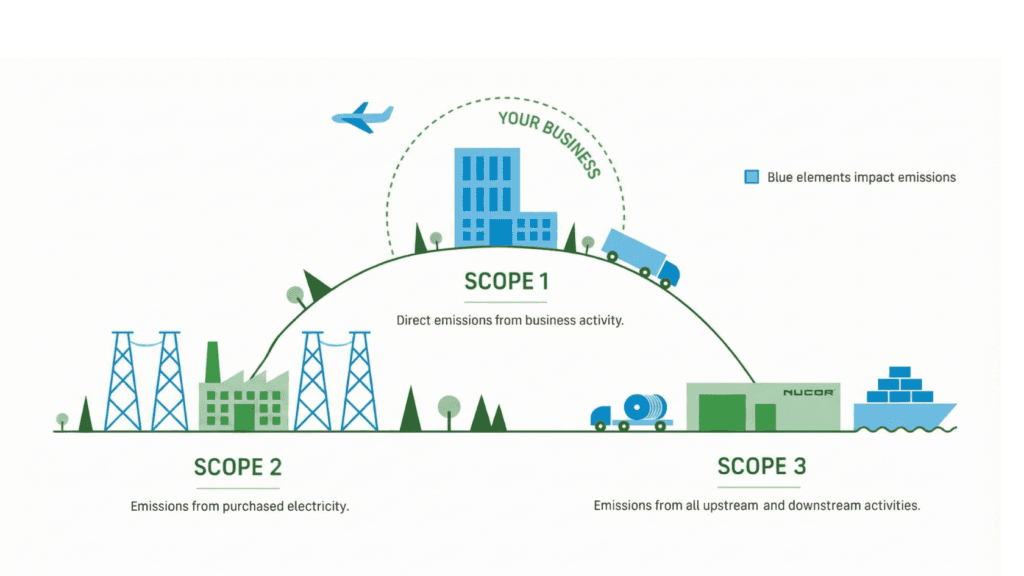
Scope 1
Direct emissions from sources the company owns or controls—fuel combustion in company vehicles, on-site generators, refrigerant leaks, industrial processes, or manufacturing equipment.
Scope 2
Indirect emissions from purchased electricity, heating, cooling, or steam consumed in company facilities—in the UAE, primarily electricity from grid consumption.
Scope 3
Value chain emissions from activities upstream and downstream of direct operations—purchased goods, business travel, employee commuting, transportation, waste disposal, and use of sold products.
Get Free Consultation With Our Experts
Standards Used for GHG Calculations in the UAE
UAE companies must adopt internationally recognized standards that provide methodological credibility and satisfy regulatory requirements.
- GHG Protocol Corporate Standard – the dominant global framework defining principles, concepts, and calculation methodologies. Expected to form the basis for UAE regulatory reporting requirements.
- ISO 14064-1 – the international standard for organizational GHG inventories, providing specification and guidance for quantification and reporting. Often required for third-party verification.
- Emission factors – UAE companies use regional factors where available (UAE electricity grids, local fuel specifications) and international databases (DEFRA, IEA, EPA) for materials, travel, and upstream activities.
These standards ensure calculations meet regulatory scrutiny and satisfy international stakeholder expectations from investors, customers, and ESG rating agencies.
How Companies in the UAE Start GHG Reporting
Step 1
Determine regulatory applicability
Assess whether your entity falls within the scope of Federal Decree-Law No. 11 of 2024 based on sector, size, or emissions thresholds once executive regulations are published.
Step 2
Define organizational boundaries
Determine which entities, facilities, and operations to include using equity share, financial control, or operational control approaches aligned with regulatory guidance.
Step 3
Set reporting period and scopes
Most UAE companies begin with Scope 1 and 2 for regulatory compliance, expanding to material Scope 3 categories for comprehensive ESG reporting.
Step 4
Identify emission sources
Map activities generating emissions across operations—vehicles, facilities, equipment, utilities, travel, logistics, and procurement.
Step 5
Collect activity data
Gather consumption records: fuel purchases, electricity bills, travel bookings, fleet mileage, refrigerant top-ups, waste disposal records.
Step 6
Calculate emissions
Apply appropriate emission factors to activity data, converting consumption into CO₂ equivalent emissions using recognized databases.
Step 7
Document methodology
Maintain transparent records of data sources, calculation approaches, assumptions, and limitations for regulatory verification and annual updates.
Step 8
Prepare regulatory submissions
Format reports according to government requirements once submission portals and templates are released by competent authorities.
Importance of GHG Reporting for UAE Businesses
Carbon transparency delivers both regulatory compliance and strategic business advantages.
- Legal compliance – meeting Federal Decree-Law No. 11 of 2024 obligations avoids potential penalties and maintains operating licenses.
- ESG ratings and assessments – platforms like EcoVadis, CDP, MSCI, and Sustainalytics require GHG data, affecting scores that influence investor decisions.
- Access to capital – banks link lending terms to sustainability performance, with carbon disclosure prerequisite for green financing.
- Procurement qualification – government projects and multinational contracts incorporate carbon criteria in supplier evaluation.
- Supply chain requirements – international brands require Scope 3 data as they report downstream emissions.
- Operational insights – GHG accounting reveals energy inefficiencies and cost-saving opportunities.
Planet First Consultants – GHG Reporting Support in the UAE
Planet First supports UAE companies developing compliant GHG inventories meeting Federal Decree-Law No. 11 requirements and international standards.
Our approach combines regulatory knowledge with practical understanding of UAE business operations, data constraints, and reporting use cases.
Services include:
- Regulatory applicability assessment under new climate legislation
- Organizational boundary definition and scope determination
- Activity data collection protocol development
- Emission calculations following GHG Protocol and ISO 14064-1
- Methodology documentation for regulatory and third-party verification
- Government reporting preparation and submission support
- ESG platform reporting for investors and customers
- Year-over-year tracking and continuous improvement
We work across sectors including construction, logistics, manufacturing, real estate, hospitality, and professional services—helping companies navigate compliance from initial inventory through ongoing reporting cycles.
Get Free Consultation With Our Experts
- All Posts
- blog
- Cases

ISO 14019: What You Need to Know About the New Sustainability Verification Standard If you’ve...

How to Read an EPD: A Practical Guide for Construction Professionals Why EPDs Are Often...

Everything You Need to Know About EPDs: All Questions Answered Home Everything You Need to...

Case Study 2 Home How Planet First Helped a Market Intelligence Firm Improve Its EcoVadis...

EPD Program Operators: How to Choose, Credibility, and Global Overview If you’re a UAE business...

Why Companies Fail EcoVadis Before Scoring Even Starts: The 55-Document Trap You’ve gathered everything—environmental policies,...
Boost Your EcoVadis Rating with Expert Help
Work with Planet First, the EcoVadis-Certified consultants in the Middle East, and ensure your sustainability performance is fully recognized.
info@theplanetfirst.org
Phone
+971 50 25 35 594

A sustainability consultancy supporting ESG reporting, carbon footprint calculations, and compliance for businesses.
Main Services
GCC/Middle East Specific
Contact
- 112, Normandy 2, Al Nadha 2, Dubai, UAE
- info@theplanetfirst.org
- +971 50 253 5594